Category: Business Tools

  • Are Your Sales Outgrowing WhatsApp?

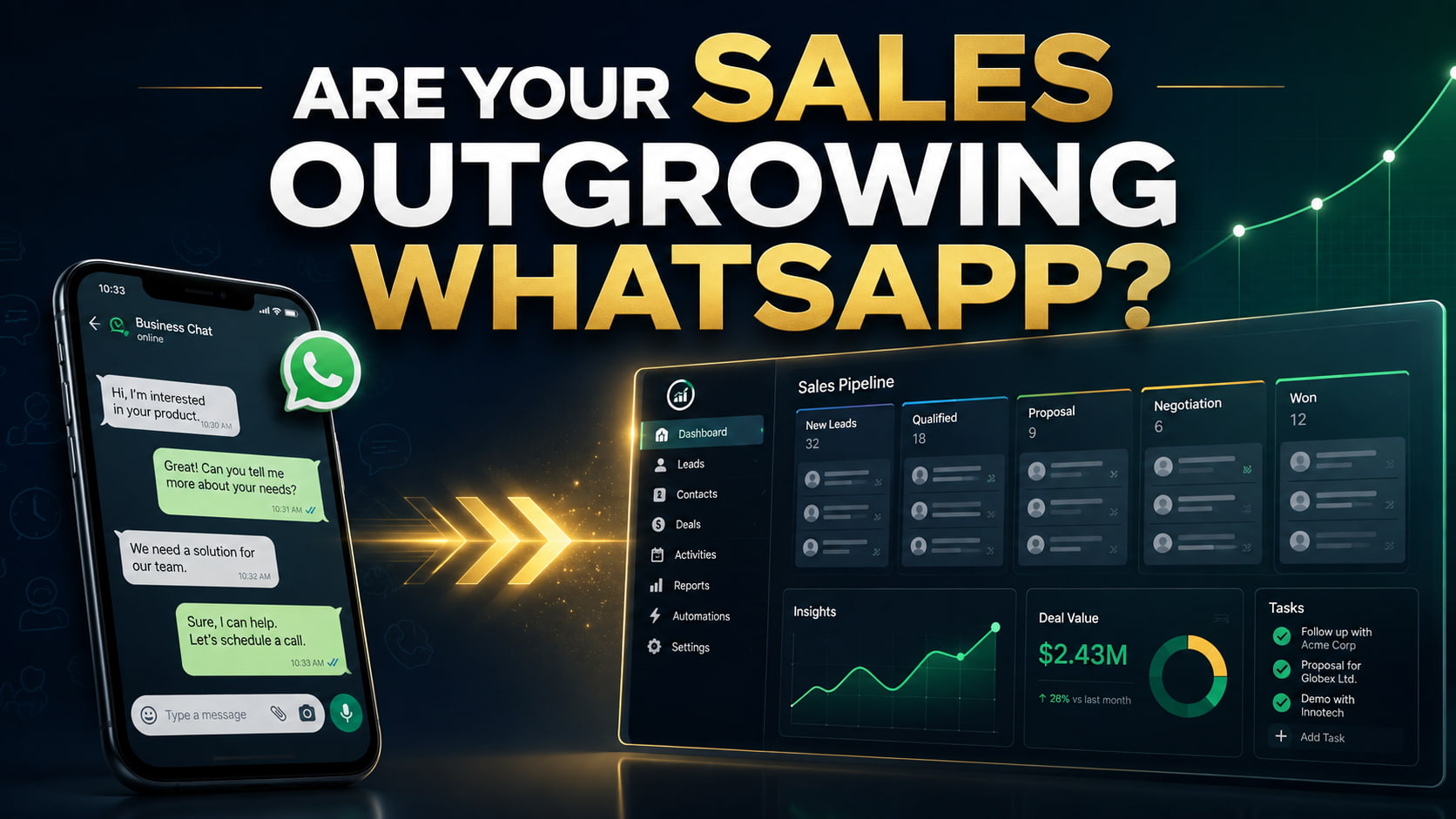
    Are Your Sales Outgrowing WhatsApp?

    A customer sends your business a WhatsApp message.

    They ask about a product. Someone replies. A quotation is sent. The customer says they will make a decision next week.

    Three days later, another enquiry arrives.

    Then another.

    One salesperson remembers to follow up. Another assumes somebody else has already replied. A customer waiting for a revised quotation slowly disappears underneath newer chats.

    Two months later, an old prospect returns, but the employee who originally handled them is away.

    Nothing is technically wrong with WhatsApp.

    Every conversation is still there.

    The problem is that the business is beginning to depend on people remembering what those conversations mean.

    Who owns this lead?

    What was promised?

    What happens next?

    When should somebody follow up?

    How much is the opportunity worth?

    At some point, a business that sells through WhatsApp has to ask:

    Are our sales beginning to outgrow the chat?

    The answer is not simply “yes” because the company has become bigger.

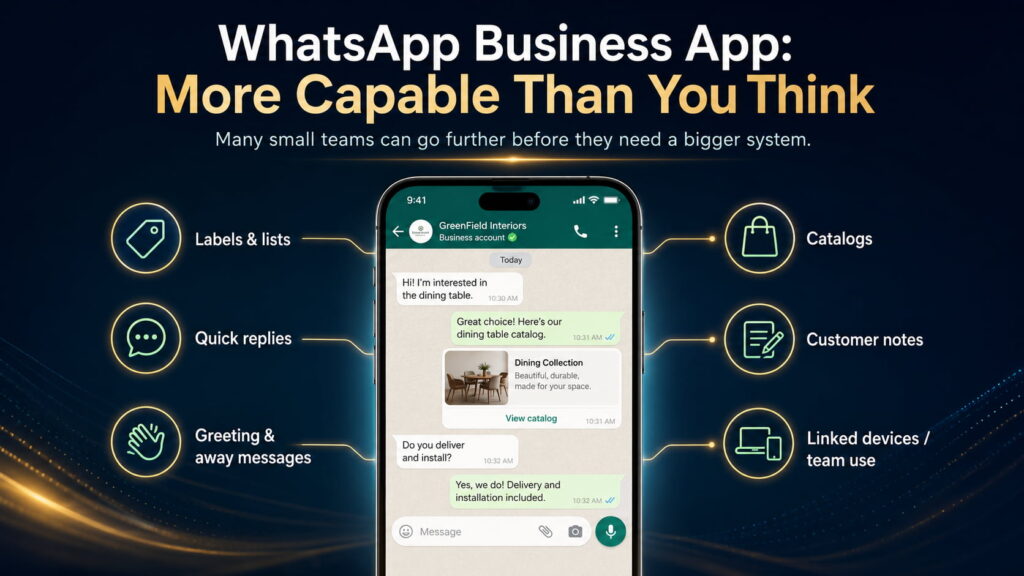
    WhatsApp Business itself has become considerably more capable. It now encourages businesses to use Lists to organize customers around stages such as New inquiry, Pending info, Order in progress, Payment pending, Completed and Follow up. It also includes quick replies, greeting and away messages, catalogs and other tools designed specifically for small-business conversations.

    So the real question is not when to abandon WhatsApp.

    It is:

    When does managing the sale require more structure than the conversation can reliably carry?


    WhatsApp can take a small business surprisingly far

    A lot of advice about “graduating from WhatsApp” starts too early.

    If a small team occasionally loses track of a follow-up, the first response should not necessarily be:

    Buy a CRM.

    It may be:

    Use WhatsApp Business properly.

    WhatsApp recommends organizing chats into Lists that reflect the customer journey and maintaining a daily routine for reviewing and labeling open conversations. Quick replies can remove repetitive typing, while greeting and away messages help maintain consistent responses.

    The Business app also supports up to four linked devices on one number, allowing several team members to view and answer conversations. For eligible businesses, Meta Verified adds multi-agent functionality including chat assignment.

    And Meta Business Suite adds another layer.

    Its Inbox can bring WhatsApp, Instagram and Messenger conversations into one place. Teams can filter conversations requiring follow-up, see who a conversation is assigned to, add customer details and private notes, use labels and configure simple automations.

    For many small businesses, that may be enough.
    The cheapest software problem is often the one you can solve with tools you already have.


    There is no magic number of messages where WhatsApp becomes inadequate

    It would be convenient to say:

    50 enquiries a day = time for a CRM.

    Or:

    Five salespeople = WhatsApp is no longer enough.

    The research does not support a universal threshold.

    Consider a restaurant processing hundreds of WhatsApp conversations each week:

    menu → order → payment → delivery → complete

    It may have little need for opportunity values, closing probabilities or pipeline forecasts.

    Now consider a consultancy with only 15 serious prospects.

    Each opportunity might take months to close and be worth tens of thousands of dollars.

    Management may need to know:

    • who owns each opportunity;
    • what stage it has reached;
    • proposal value;
    • next meeting;
    • expected close date;
    • objections;
    • source;
    • probability of closing.

    The consultancy may need a structured sales system far earlier despite receiving dramatically fewer messages.

    The complexity of the sale matters more than the number of chats.


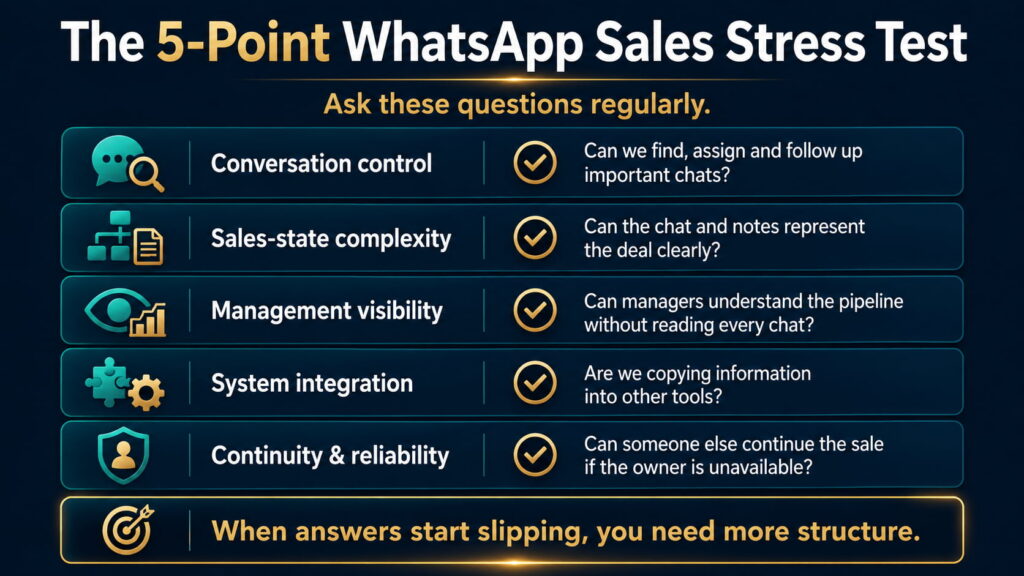
    Five questions reveal whether the system is starting to strain

    Instead of counting messages, test the sales process itself.
    1. Conversation control

    Can we reliably find, assign and follow up every important conversation?

    If Lists, follow-up routines and assignment solve this, WhatsApp may still be perfectly adequate.

    2. Sales-state complexity

    Can the conversation, Lists and notes represent everything we need to know about the opportunity?

    If the business increasingly needs structured fields such as deal value, stage, expected close and next activity, the requirement is changing.

    3. Management visibility

    Can a manager understand what is happening across all active opportunities without reading individual conversations?

    If answering a basic question such as “What could close this month?” requires opening 40 chats, the inbox is being asked to do a job it was not designed to do efficiently.

    4. System integration

    Are employees repeatedly copying information from WhatsApp into spreadsheets, invoicing systems, order systems or another database?

    Manual duplication is often a sign that another layer should be connected rather than maintained separately.

    5. Continuity

    If the salesperson handling the account disappeared tomorrow, could someone else continue correctly?

    If the real sales state exists partly in the conversation and partly in one person’s memory, the process has become fragile.

    A business does not need to fail every test before acting.

    But the more answers become uncomfortable, the stronger the case for additional structure.


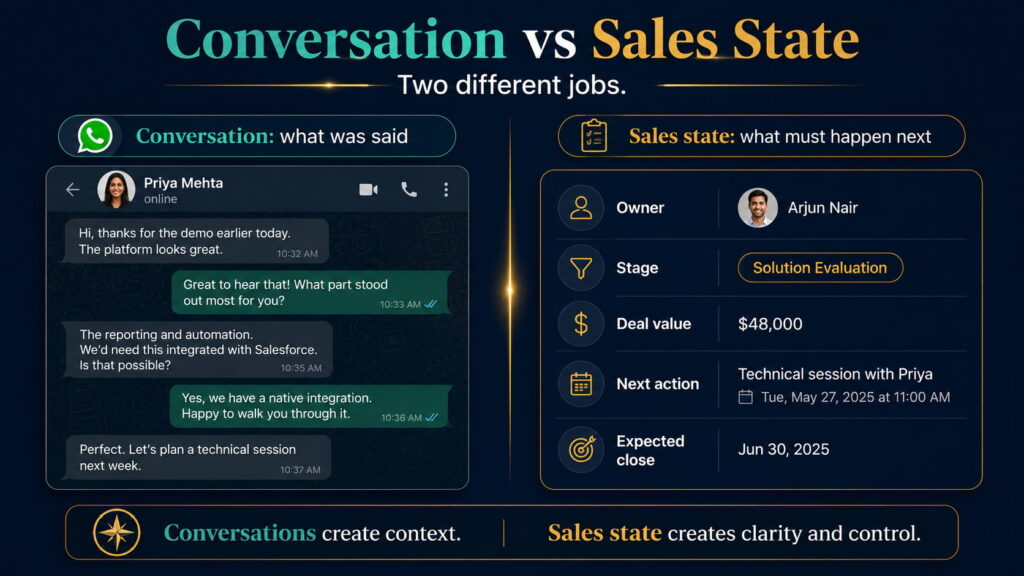
    A conversation and a sales record do different jobs

    Consider this WhatsApp exchange:

    “Thanks. I’ve sent the revised quotation. Let’s speak Thursday.”

    A person reading the chat understands what happened.

    But management may eventually need something different:

    Owner: Mary
    Stage: Proposal
    Deal value: $12,000
    Next action: Follow up Thursday
    Expected close: September
    Lead source: Website

    Both records describe the same sale.

    They are not interchangeable.

    The conversation provides context.

    Structured sales data provides control and visibility.

    With structured information, a business can answer questions such as:

    Which opportunities have no next action?

    How much pipeline does each salesperson hold?

    Which lead source produces the most valuable opportunities?

    How many proposals have been waiting more than two weeks?

    What might close next month?

    That is where a CRM—or another structured sales system—starts creating value.

    Not because WhatsApp has somehow become bad.

    Because the business now needs a different kind of information.

    Add the smallest layer that solves the problem

    The sensible upgrade path is not:

    WhatsApp → giant CRM.

    It is gradual.

    Start with WhatsApp Business

    Use Lists, notes, quick replies and disciplined follow-up.

    If that solves the problem, stop.

    Add native team tools when coordination becomes difficult

    If several people need to handle one number, linked devices, Meta Business Suite and eligible Meta Verified multi-agent tools may solve the problem without introducing another platform.

    Add the WhatsApp Business Platform when integration or automation becomes necessary

    If the business needs deeper routing, CRM integration, automation or a larger operational layer, WhatsApp says businesses can connect the Business app to the Business Platform using the same number while retaining the app, number and chat history.

    Add a structured sales system when the sale itself needs one

    If management needs deal stages, values, pipeline reporting, attribution, forecasting or richer customer history, a CRM or equivalent system of record becomes much easier to justify.
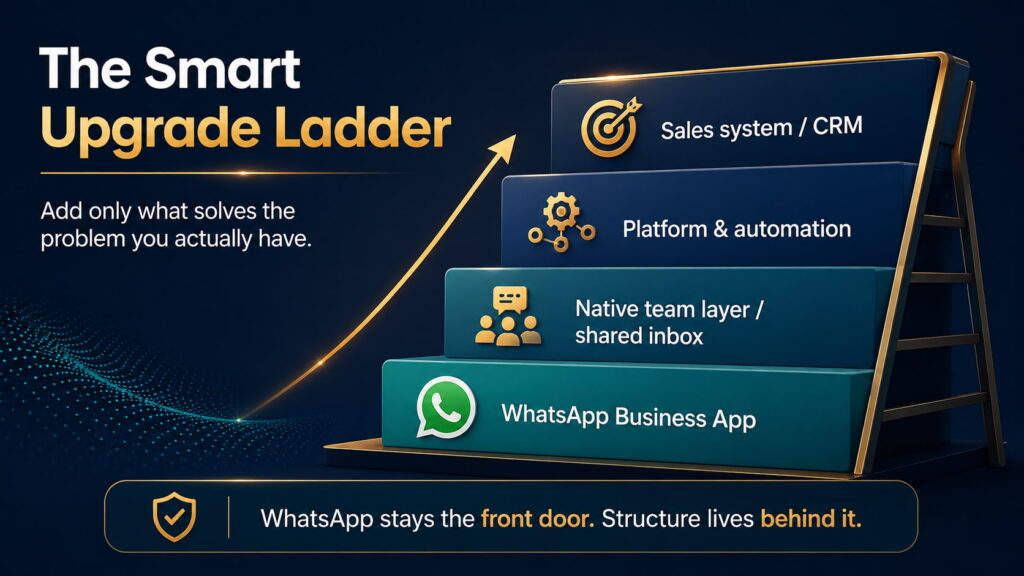
    The principle is simple:

    Add only the layer that solves the problem you actually have.


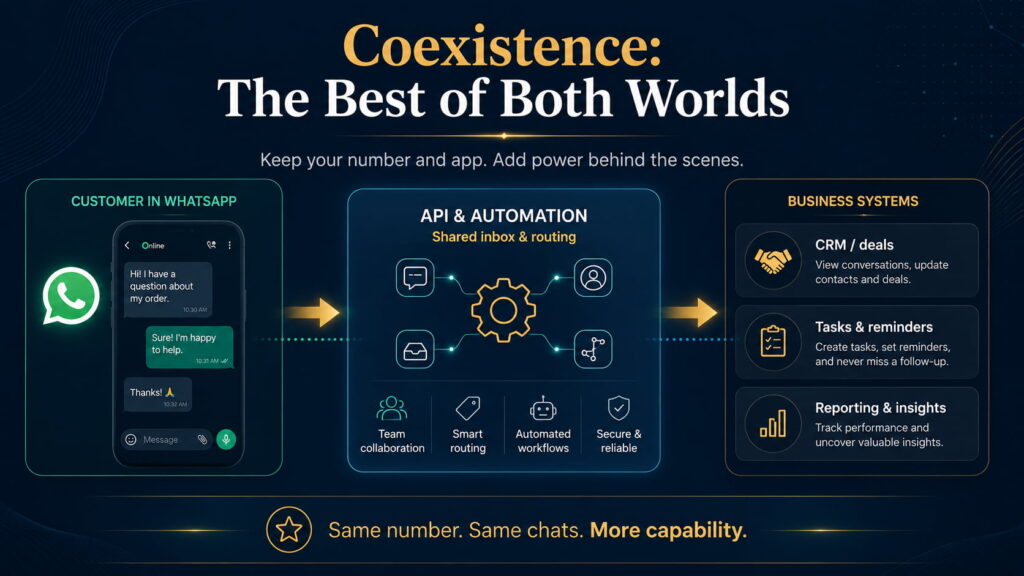
    WhatsApp can remain the front door

    One of the more important changes in WhatsApp’s current architecture is that improving internal systems does not necessarily mean forcing customers to change how they communicate.

    That is a mistake businesses should avoid.

    Customers may already prefer WhatsApp.

    Employees may already understand it.

    The telephone number may already be advertised everywhere.

    The objective should therefore often be:

    keep WhatsApp in front and put better systems behind it.

    A customer sends the same WhatsApp message as before.

    Behind the scenes, however:

    the enquiry can be routed → ownership recorded → customer information synchronized → a next action created → pipeline information updated → management reporting improved.

    From the customer’s perspective, nothing became more complicated.

    From the company’s perspective, the sale became considerably more manageable.

    AI raises the WhatsApp ceiling even further

    Meta is also adding more AI directly to business messaging.

    Meta Business Agent is designed to answer customer questions, provide recommendations and support commerce, while Meta says more than one million businesses were already using its Business Agent by June 2026. Its wider Business Agent Platform is also designed to connect with companies’ existing systems.

    That can remove a substantial amount of conversational workload.

    But it does not eliminate the difference between:

    handling the customer conversation

    and

    managing the commercial state of the business.

    An AI agent may be able to answer:

    “Do you deliver?”

    It might qualify an enquiry or help a customer choose a product.

    Management may still need to ask:

    “What is the total value of qualified opportunities expected to close next month?”

    Those are different problems.

    AI can raise the conversational ceiling without making structured business systems unnecessary.


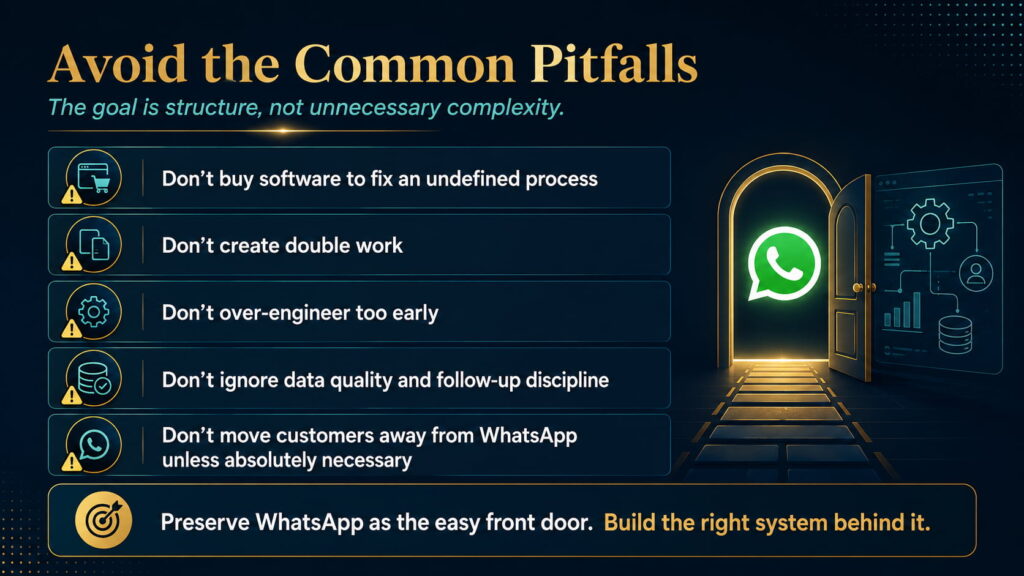
    Do not replace WhatsApp chaos with CRM chaos

    Adding another system can also make things worse.

    Imagine salespeople still speaking to customers on WhatsApp but now being required to manually copy every interaction, contact detail, next action and note into a CRM.

    The business has not necessarily reduced work.

    It may simply have created two systems employees must maintain.

    Soon:

    some information is in WhatsApp;

    some is in the CRM;

    some is in a spreadsheet;

    and the salesperson remembers the rest.

    That can be worse than the original problem.

    A better architecture should capture information automatically wherever practical.

    The salesperson should ideally add only the information the system cannot reliably infer—perhaps deal value, stage, expected close or an important commercial judgment.

    Structure should reduce dependence on manual administration, not create more of it.

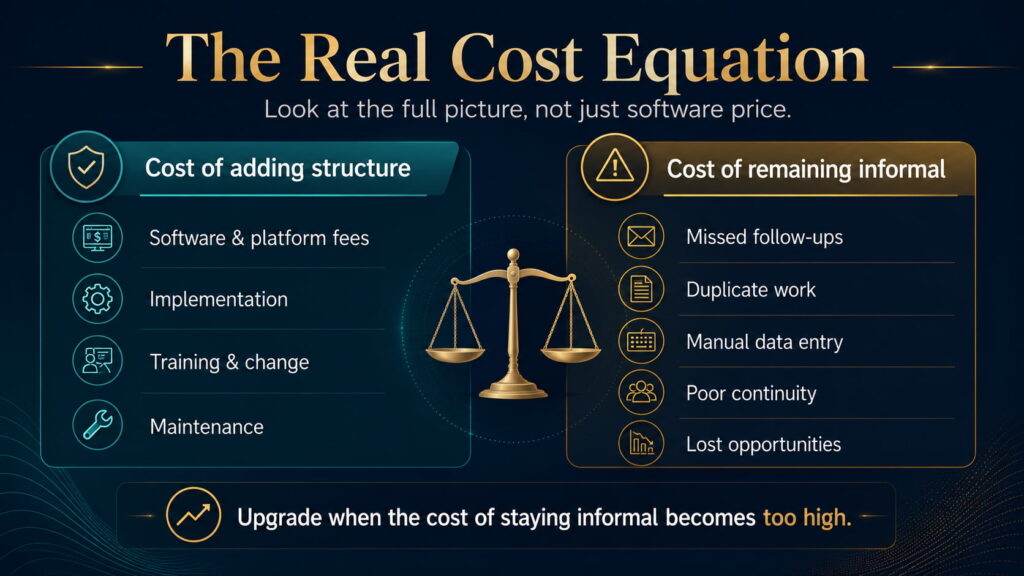
    The cost of upgrading is only half the equation

    Moving to the WhatsApp Business Platform can introduce messaging charges.

    WhatsApp’s current pricing model charges businesses per delivered message, with rates depending on the recipient market and message category. Service messages are free, as are utility messages sent in response to users. When a customer messages a business, a 24-hour customer-service window opens in which service responses are free. Certain click-to-WhatsApp entry points can also create a 72-hour period in which messages are not charged.

    Additional systems may then introduce:

    • software subscriptions;
    • implementation;
    • integrations;
    • training;
    • maintenance;
    • automation or AI usage charges.

    But comparing those costs only against free WhatsApp is misleading.

    Remaining informal also has potential costs:

    • missed follow-ups;
    • lost opportunities;
    • duplicate replies;
    • repeated data entry;
    • poor continuity;
    • weak pipeline visibility.

    The correct question is therefore not:

    How much does the software cost?

    It is:

    Has the cost of running sales informally become greater than the cost of adding structure?


    Some businesses may never need a conventional CRM

    That is entirely possible.

    A salon might operate:

    enquiry → booking → reminder → appointment

    A retailer:

    question → order → payment → delivery

    If WhatsApp Business and simple automation handle those processes reliably, adding a conventional sales CRM may create administration without creating enough additional value.

    Growth does not automatically require more software.

    Conversely, a tiny company selling complicated high-value deals may need structured pipeline management almost immediately.

    The right system depends on how the business sells.


    So, are your sales outgrowing WhatsApp?

    Not because you received your hundredth message.

    Not because a second employee joined the sales team.

    And not because somebody said a serious company needs a CRM.

    Your sales are beginning to outgrow WhatsApp when the information required to manage them can no longer be represented, maintained and understood reliably using the conversation and the native organizational tools available to you.

    Until then, organizing WhatsApp better may be the correct answer.

    After that, add the smallest missing layer.

    If teamwork is broken, improve teamwork.

    If automation or integration is missing, investigate the Business Platform.

    If structured opportunities, pipeline reporting and forecasting have become necessary, add a sales system behind WhatsApp.

    But wherever possible, keep the customer experience simple.

    Your customer does not care how sophisticated your internal technology stack is.

    They care that somebody remembers what was promised, follows up when expected and moves the conversation forward.

    The real tipping point is therefore not:

    “Are we too big for WhatsApp?”

    It is:

    “Has managing the sale become more complex than the conversation can reliably carry?”

    When the answer becomes yes, it is time to add structure—not necessarily to replace WhatsApp.
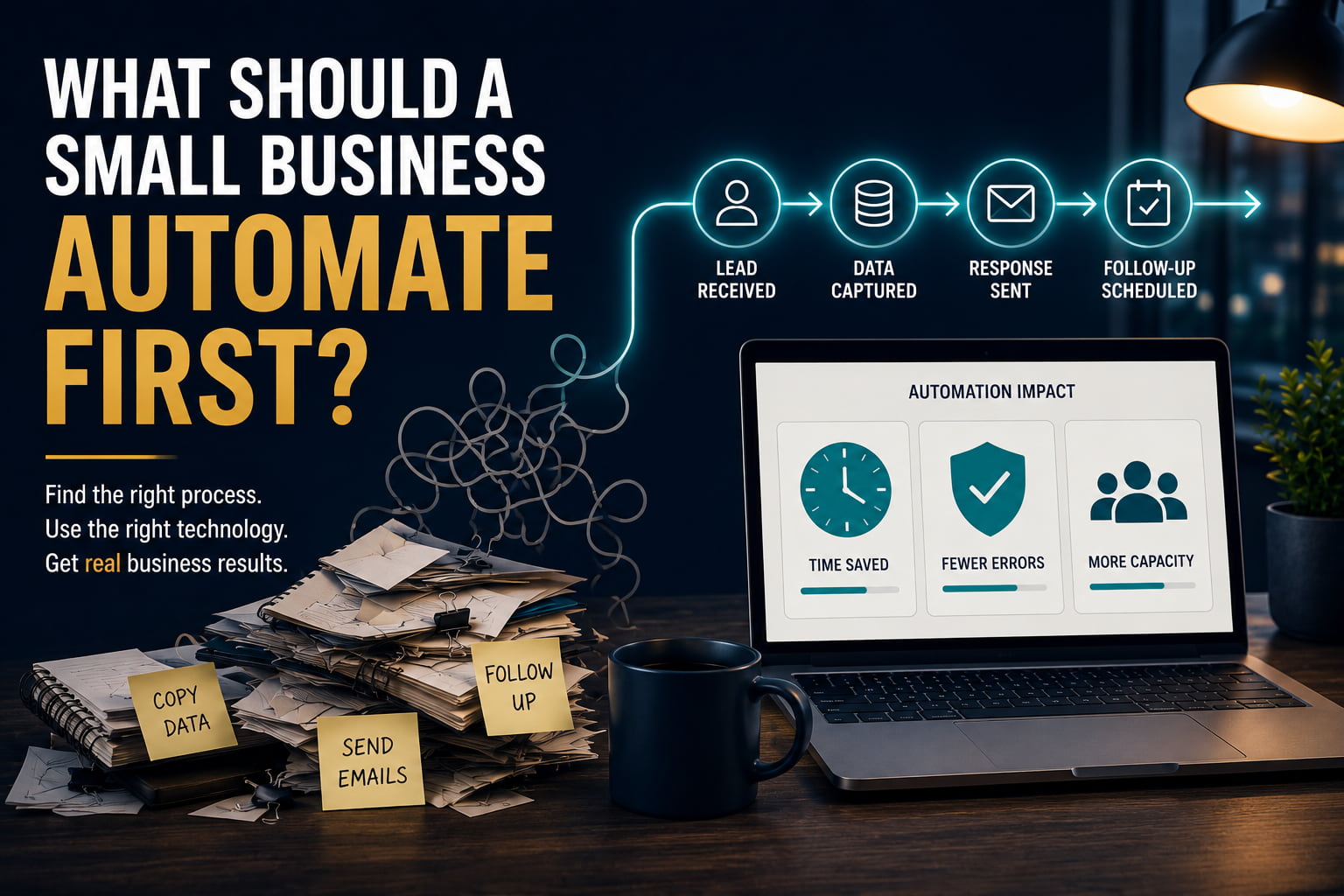
  • What Should a Small Business Automate First?

    What Should a Small Business Automate First?

    A customer fills in a form on your website. Someone notices the email twenty minutes later and forwards it to the right person. That person copies the customer’s details into a spreadsheet or CRM, sends a message, and makes a note to follow up later.

    Meanwhile, somebody else is checking which invoices are overdue. Appointments are being confirmed one by one. Information is being copied from one system into another. A weekly report is being rebuilt from data that already exists in three different places.

    None of this work is particularly difficult.

    But together, it can consume hours.

    Eventually somebody asks the obvious question:

    Can we automate this?

    The question is increasingly relevant. The OECD’s 2026 D4SME survey, based on a non-representative sample of more than 2,000 SMEs across 12 OECD countries, found that adoption of AI tools is increasing rapidly. But strategic, targeted and secure integration into business operations remains uneven, with time constraints, maintenance costs and skills gaps continuing to impede implementation.

    There is also an important distinction hiding inside the current AI boom.

    A 2026 U.S. Chamber of Commerce Foundation/Ipsos study found that half of workers at small businesses were already using AI at work. But among those using AI, 64% said their primary use was personal productivity such as drafting, summarising and brainstorming. Another 26% used it for recurring tasks. Only 6% said they were using AI to automate workflows with minimal human involvement.

    Using AI is therefore not the same thing as automating a business.

    And before choosing Zapier, Make, n8n, an AI agent or anything else, there is a more important question:

    Of everything your business does repeatedly, what should you automate first?


    Everyone says automate. But automate what?

    The easiest mistake is to begin with the software.

    A business subscribes to an automation platform because automation is supposed to save time. Someone watches a demonstration of an AI agent updating spreadsheets, sending emails and moving information between applications, and the conversation becomes:

    What could we make this tool do?

    That reverses the order.

    The business should first identify a workflow worth improving.

    Only then should it decide what technology, if any, belongs inside that workflow.

    Not all repetitive work deserves automation. A tedious task that takes an employee ten minutes twice a year may be irritating but commercially insignificant. A three-minute task performed 150 times every week may barely be noticed yet consume a substantial amount of staff time.

    Another process may consume many hours but still be a poor automation candidate because every case requires unusual judgment. A different process may be extremely easy to automate but so unimportant that doing so creates almost no measurable value.

    The starting question is therefore not:

    What can this software automate?

    It is:

    Where is the business repeatedly losing time, money, reliability or opportunity?


    Before automating a process, ask whether it should exist

    Automation can make a bad process run faster.

    That does not make it a good process.

    A 2026 systematic review examining 83 peer-reviewed studies of robotic process automation and business process management found that successful automation depends not only on technology but on process selection, implementation, lifecycle management, governance and continued improvement. The traditional automation literature consistently favors processes that are high-volume, rule-driven, digitally accessible and sufficiently stable.

    Modern AI expands what can be automated, particularly where inputs are unstructured or interpretation is required. It does not remove the need to understand the underlying work.

    So before asking how to automate something, ask a more uncomfortable question:

    Why are we doing this at all?

    A report that nobody reads does not need automated reporting. It needs deleting.

    An approval that exists only because “we have always done it this way” may not need an automated approval system. It may need removing.

    A form that asks a customer for information the company already possesses may not need an automated data-transfer workflow. The duplicate request may need eliminating.

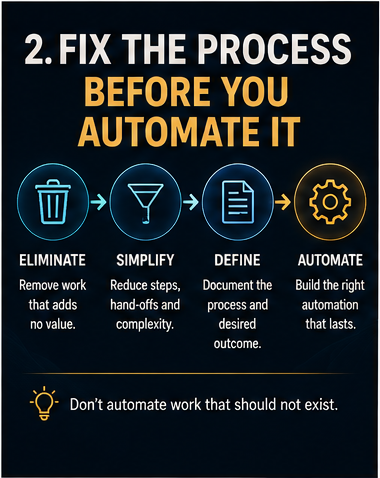
    A useful sequence is therefore:

    Eliminate → Simplify → Define → Automate

    The word define matters.

    Traditional automation generally needs a predictable sequence of actions. AI can tolerate considerably more variation in the inputs and, in some cases, the route taken. But the business still needs to understand the objective, acceptable outcomes, important exceptions and boundaries.

    Automation cannot reliably fix a process the business itself does not understand.


    Four questions determine whether a process is ready for automation

    There is no universal formula that can tell every business what to automate.

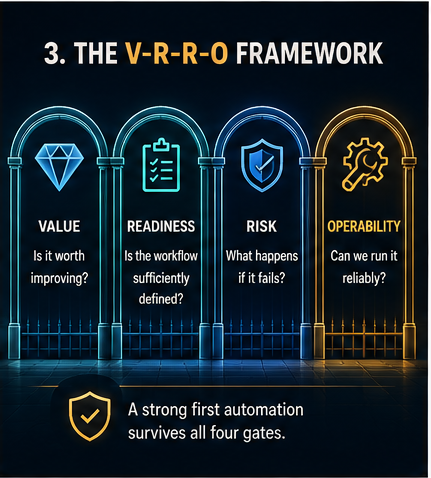
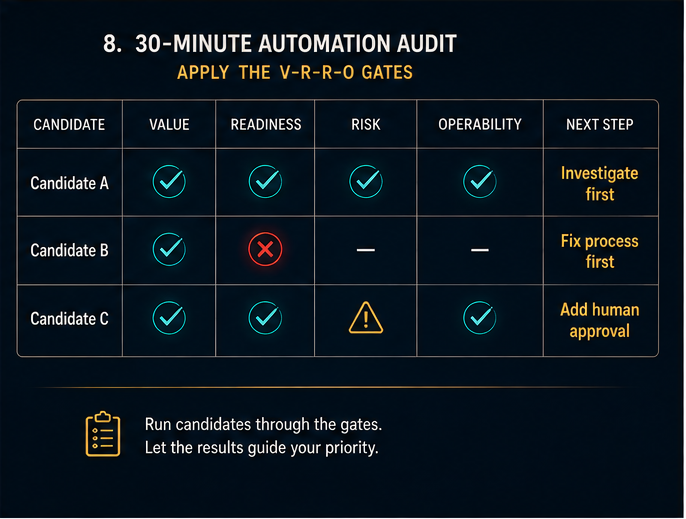
    But the research repeatedly points toward several factors that matter. We have combined them into what we call the NakuNet Value–Readiness–Risk–Operability framework.

    This is an editorial decision framework synthesised from the evidence, not a scientifically validated scoring formula. We deliberately do not turn it into an overall score such as “82% automation ready.”

    Why?

    Because averaging the factors can hide what matters.

    An automation could have enormous potential value but unacceptable risk. Another could be technically simple but impossible for the business to maintain reliably.

    The four gates should therefore be considered separately.

    GateQuestion
    ValueIs improving this workflow worth doing?
    ReadinessIs the work sufficiently understood and bounded?
    RiskWhat happens when the automation gets something wrong?
    OperabilityCan the business reliably run and maintain it afterwards?

    A good first automation should survive all four.


    Gate 1: Value — is the problem worth solving?

    Start with what actually happens today.

    How often does the workflow occur? How long does each occurrence take? How many employees touch it? Do delays affect revenue or cash flow? Do mistakes create rework? Does the process repeatedly interrupt people who could be doing higher-value work?

    Consider two hypothetical processes.

    Process A happens once every three months and takes an employee two hours.

    Process B requires somebody to spend two minutes copying enquiry details into a CRM, but it happens 25 times every working day.

    Process A feels worse when somebody has to perform it.

    Process B consumes far more labour over the year.

    Frequency matters.

    But time is not the only source of value.

    Automating lead routing might save only a few minutes per enquiry, while its greater value comes from getting prospects to the correct salesperson faster.

    An invoice reminder may save almost no intellectual effort, but forgetting it can affect cash collection.

    An appointment reminder may take seconds, while its real value may be reducing no-shows.

    Automation can therefore produce value in at least four different ways: actual cash savings, released staff capacity, protected or increased revenue, and improved reliability or reduced errors.

    Those should not be treated as though they are all the same thing.


    Gate 2: Readiness — is the workflow ready for automation?

    A process can be valuable and still not be ready.

    Traditional process-automation research consistently finds stronger candidates among workflows with frequent execution, clear rules, stable inputs, accessible data and relatively low levels of exception handling.

    AI changes part of that equation.

    Imagine a company receiving hundreds of customer emails.

    The inputs are highly variable. Customers use different words, combine several questions in one message and occasionally explain the problem badly.

    Trying to classify those emails using hundreds of rigid keyword rules could create a fragile system.

    But the output might be tightly bounded:

    Sales / Billing / Support / Other / Needs human review

    An AI model may be useful for interpreting the unpredictable language even though the surrounding workflow remains highly structured.

    So instead of asking whether every input is standardized, ask:

    Is the problem sufficiently bounded that we know what success and failure look like?

    Before automating a workflow, the business should be able to describe its trigger, expected outcome, major steps, common exceptions and success criteria.

    If five employees perform the same job in five completely different ways and nobody can explain why, the company probably has a process-design problem before it has an automation opportunity.


    Gate 3: Risk — what happens when it fails?

    This is where simplistic automation advice becomes dangerous.

    A process can be frequent, expensive and technically easy to automate while still being a poor candidate for full autonomy.

    Consider a system that approves payments.

    Perhaps the rules are clear. Perhaps employees spend substantial time processing them. Perhaps automation could save hundreds of hours.

    But one incorrect high-value payment could cost more than a year’s worth of saved labour.

    That is why risk cannot simply become another few points inside an overall automation score.

    Ask what happens when the system is wrong.

    Is the action reversible? Could a customer lose money? Could confidential information be exposed? Could a contractual commitment be created? Would anybody notice a silent failure? How much authority does the automation actually need?

    This becomes more important as businesses deploy AI agents capable of acting across several systems. NIST’s 2026 work on agent identity and authorization specifically highlights the risks associated with giving agents access to diverse datasets, applications and tools, and examines identification, authorization, auditing, delegation of authority and least-privilege controls.

    A useful principle follows:

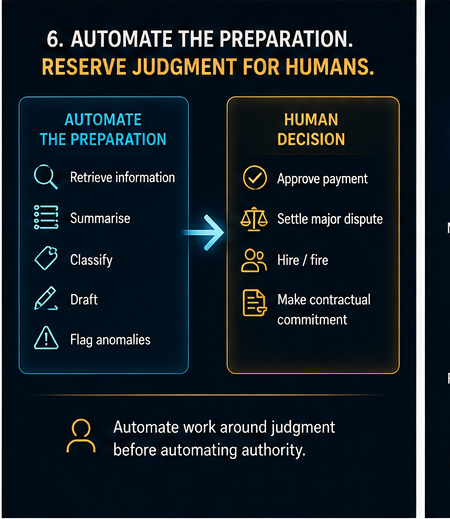
    Automate the work around high-stakes judgment before automating the judgment itself.

    A customer complaint system, for example, might retrieve the account history, locate the relevant policy, summarise what happened and prepare a draft response.

    A person can still decide whether the company should issue a substantial refund.

    Much of the administrative burden disappears without transferring unrestricted authority to the machine.


    Gate 4: Operability — can you keep it working?

    This is the part most automation demonstrations do not show.

    The demo ends when the workflow succeeds.

    The business starts living with it the following morning.

    What happens when an API changes? What happens when somebody renames a spreadsheet column? What happens when the source information is incomplete? Who receives the error? Who notices that 17 transactions failed? Who understands how to repair the workflow six months after the person who built it has left?

    The 2026 systematic review of RPA and business-process research treats automation as a lifecycle rather than a one-time implementation. Maintenance, governance, continuous improvement, integration and organizational ownership all appear as important dimensions.

    A production automation is therefore incomplete until the business knows what happens when it fails.

    Four questions expose most of the problem:

    Who owns it?

    Who gets notified when it fails?

    Can the work continue manually if necessary?

    Can we determine afterwards what happened?

    Monitoring becomes particularly important with AI-enabled systems, whose behaviour can be more variable than ordinary deterministic software. NIST’s 2026 report on deployed AI systems identifies challenges including performance degradation, fragmented logging and the difficulty of scaling human monitoring as systems expand.

    A workflow that saves three hours each month but needs four hours of maintenance has not achieved much.


    So which processes should a small business investigate first?

    There is no single answer across every business.

    A dental practice, ecommerce company, construction firm, law office and marketing agency do not experience the same bottlenecks.

    But some workflows are sensible places to investigate because they often combine repetition, measurable outcomes and manageable risk.

    WorkflowWhy investigate itLikely starting architectureWhat to measure
    Lead capture, routing and alertsTime-sensitive and revenue-linkedRules-based workflowResponse time, missed leads
    Appointment booking and remindersPredictable and reversibleRules-based workflowNo-shows, admin time
    Invoice/payment remindersRepetitive with cash-flow implicationsRules-based workflowDays overdue, chasing time
    Moving data between systemsHigh repetition and error potentialAPI/workflowHours consumed, error rate
    Recurring reports and notificationsRepeated with known outputsRules-based workflowPreparation time, corrections
    Customer/employee onboardingRepeated handoffs and remindersWorkflow automationCompletion time, missing steps
    Document extraction/generationRepetitive but may involve unstructured informationWorkflow + AIProcessing time, correction rate
    Inbox/request classificationVariable language, bounded outcomeWorkflow + AIRouting accuracy, human-review rate

    Notice what this table does not say.

    It does not say that every business should automate invoicing first.

    For some businesses, invoicing automation may be extremely valuable.

    For another company issuing ten invoices a year while processing hundreds of sales enquiries every week, it may be almost irrelevant.

    The point is to examine promising workflows through the four gates and see where value, readiness, manageable risk and operability meet.


    Rules, AI or an agent?

    One of the easiest ways to make automation unnecessarily expensive is to use more sophisticated technology than the problem requires.

    AI is not automatically better automation.

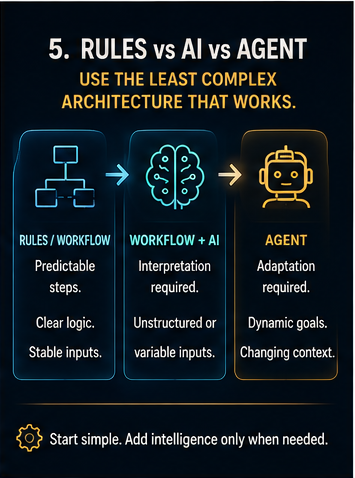
    One useful way to separate the available architectures is to distinguish fixed workflows, workflows that use AI for an interpretive step, and agents that can adapt their route across several steps. OpenAI’s current guidance uses essentially this distinction: predefined workflow automation is suited to stable repetitive tasks, while agents add the ability to plan, choose tools and adapt when conditions change.

    That gives us a useful rule:

    Use the least complex architecture that reliably solves the problem.

    If the requirement is:

    Invoice becomes seven days overdue → send reminder.

    That probably does not require an AI agent.

    If the requirement is:

    Read this incoming message and determine whether it is a billing enquiry, sales enquiry or complaint.

    An AI classification step might be simpler and easier to maintain than an enormous set of keyword rules.

    If the requirement is:

    Research a potential customer, gather information from several sources, decide which information matters, prepare a briefing and adapt when information is missing.

    That begins to resemble agentic work.

    And the technologies do not have to be mutually exclusive.

    A fixed workflow can invoke an AI model for one interpretive step and then return to ordinary automation.

    An agent can operate inside boundaries enforced by deterministic rules.

    There is no prize for making an automation more intelligent than necessary.


    Human involvement should depend on consequence, not fashion

    The debate is often framed as a choice between letting AI run autonomously and “keeping a human in the loop.”

    The better question is:

    Where does human judgment create enough value to justify the delay and cost?

    For routine, reversible and low-consequence actions, requiring manual approval every time can eliminate much of the benefit of automation.

    But for a substantial payment, sensitive dispute, hiring decision, legal judgment or contractual commitment, human authority may be essential.

    OpenAI’s current agent guidance explicitly emphasizes guardrails, confirmation and human supervision for sensitive or higher-risk actions, while limiting what agents are permitted to do.

    The useful boundary is often between automating preparation and automating authority.

    A hiring workflow might collect applications, extract experience and prepare structured summaries while a person makes the employment decision.

    A complaint workflow can retrieve history and draft possible responses while a manager approves substantial compensation.

    A finance workflow can reconcile information, identify anomalies and prepare a payment while a responsible person authorizes a large transfer.

    The strongest architecture is often neither fully manual nor fully autonomous.

    Routine cases can pass automatically. Unusual or low-confidence cases can escalate. High-consequence actions can require approval. Repeated failures can stop the automation.

    The objective is to remove unnecessary human work without removing necessary human accountability.


    Do not confuse time saved with money saved

    Automation vendors understandably like calculations showing how many hours their software saves.

    Those calculations can be useful.

    But they are often misinterpreted.

    Suppose reliable measurement shows that a workflow previously required 100 hours of employee time per month and automation reduces that to 30.

    The business has released roughly 70 hours of capacity.

    It has not necessarily saved 70 hours of payroll cash.

    The U.S. Chamber/Ipsos research illustrates the difference. Among small-business AI users experiencing productivity gains, 59% said they used the resulting time to perform more work or produce higher-quality work. Time was also redirected toward learning, planning and new responsibilities.

    The economic case should therefore distinguish different kinds of value.

    Hard financial savings happen when cash genuinely changes: perhaps overtime disappears, contractor hours fall or rework costs decline.

    Capacity value occurs when employees have more time available for productive work.

    Revenue value may come from faster lead handling, fewer missed follow-ups, faster invoicing or fewer no-shows.

    Quality and risk value can come from fewer mistakes, better consistency or stronger auditability.

    And the cost side must include more than the subscription:

    implementation + software + integrations + usage charges + maintenance + monitoring + exception handling + failure/rework cost

    A cheap automation with expensive failures may not be cheap at all.


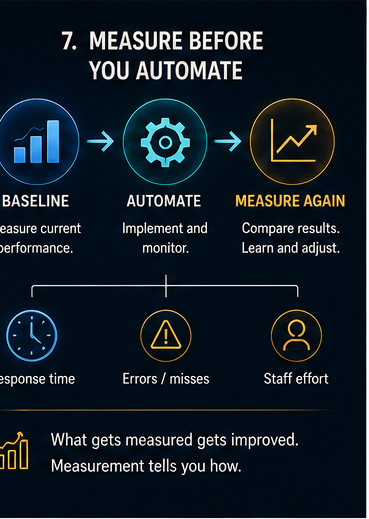
    Measure before you automate

    There is one step businesses often skip entirely.

    Before changing the workflow, establish what happens today.

    Otherwise there is nothing reliable to compare the new system against.

    You do not need an analytics department. A small baseline is enough.

    WorkflowUseful baseline
    Lead handlingResponse time, missed leads, conversion
    AppointmentsNo-show rate, admin time per booking
    InvoicingDays to payment, overdue invoices, chasing time
    Data entryTransactions processed, time per transaction, correction rate
    Customer supportResponse time, resolution time, reopened issues
    ReportingStaff hours per report, errors and corrections

    If nobody knows the current lead-response time, then after automation saying “we respond much faster now” is an impression.

    It is not a result.

    A better sequence is:

    Measure → Improve → Automate → Measure again

    That turns automation from an interesting technology project into an operational experiment.


    A simple 30-minute automation audit

    You do not need to begin with a large transformation project.

    Look at what actually happened during the previous week or month.

    Identify a handful of workflows where people repeatedly copy information, chase somebody, send reminders, check statuses, recreate reports, move records between systems or perform the same routine decision.

    Then examine each candidate.

    QuestionCandidate ACandidate BCandidate C
    How many times did it happen last month?
    Approximate minutes per occurrence?
    How many errors, delays or misses?
    Is the trigger clear?
    Is the desired outcome clear?
    Are exceptions manageable?
    Is failure low-consequence or reversible?
    Who would own the automation?
    How would failure be detected?
    Can improvement be measured?

    Do not worry about creating an overall score.

    The discussion is more useful than the number.

    If a candidate looks excellent until somebody asks, “How would we know if it silently stopped working?”, that question has exposed an important weakness.

    A boring workflow that answers every question cleanly may be the better first automation.


    Start smaller than the whole process—but bigger than a gimmick

    There are two opposite mistakes.

    One is trying to automate an entire department.

    The other is choosing a pilot so trivial that even perfect success proves almost nothing.

    A better first project is the smallest useful slice of an important workflow.

    Suppose the real problem is missed sales enquiries.

    You do not need to begin by building an autonomous AI salesperson.

    A useful first version might simply:

    capture every enquiry → create the record → assign ownership → acknowledge receipt → notify the responsible person → create a follow-up if nothing happens

    That already solves a real business problem.

    Now measure it.

    Did response times fall?

    Were fewer leads missed?

    How often did the workflow fail?

    How much administration disappeared?

    Only then decide whether AI should classify enquiries, draft responses or perform more of the sales workflow.

    Automation should expand because evidence justifies expansion, not simply because the software offers another feature.


    Security becomes more important as automation gains authority

    The OECD’s 2026 SME research identifies cybersecurity as an important digitalisation challenge. That becomes particularly relevant when software is no longer merely storing or analysing information but is being given permission to act across multiple business systems.

    NIST’s current agent-security work similarly focuses on authorization, delegation, auditing and the risks created when software agents gain access to multiple tools and data sources.

    A useful principle is:

    Give every automation the minimum authority required to perform its job.

    If it only needs to read information, it may not require unrestricted write access.

    If it only needs to prepare a draft, it may not need permission to send it.

    If it needs to recommend an action, it may not need permission to approve it.

    That does not make automation powerless.

    It limits the damage one failure can cause.


    So what should a small business automate first?

    Not the process with the most impressive AI demonstration.

    Not necessarily the task employees complain about most.

    Not whatever an automation platform happens to promote.

    And not automatically the process that consumes the greatest number of staff hours.

    The strongest first candidate is usually a bounded, recurring workflow that creates meaningful business value, is understood well enough to measure, has manageable consequences when something goes wrong, and can be monitored and maintained after launch.

    For one company that may be lead follow-up.

    For another, invoice reminders.

    For another, appointment confirmations.

    For another, it may simply be stopping employees from entering the same information into three different systems every day.

    The technology comes afterwards.

    Use ordinary workflow automation when ordinary rules solve the problem.

    Add AI when interpretation creates genuine value.

    Use agents when the work genuinely requires adaptation and multi-step reasoning.

    Keep people where judgment, empathy, authority and accountability justify their involvement.

    The question is therefore not:

    How much of our business can we automate?

    It is:

    Where can automation remove unnecessary work without creating a more expensive problem somewhere else?

    That is a much better place to start.

  • Which CRM Is Actually Best for a Small Business in 2026?

    Which CRM Is Actually Best for a Small Business in 2026?

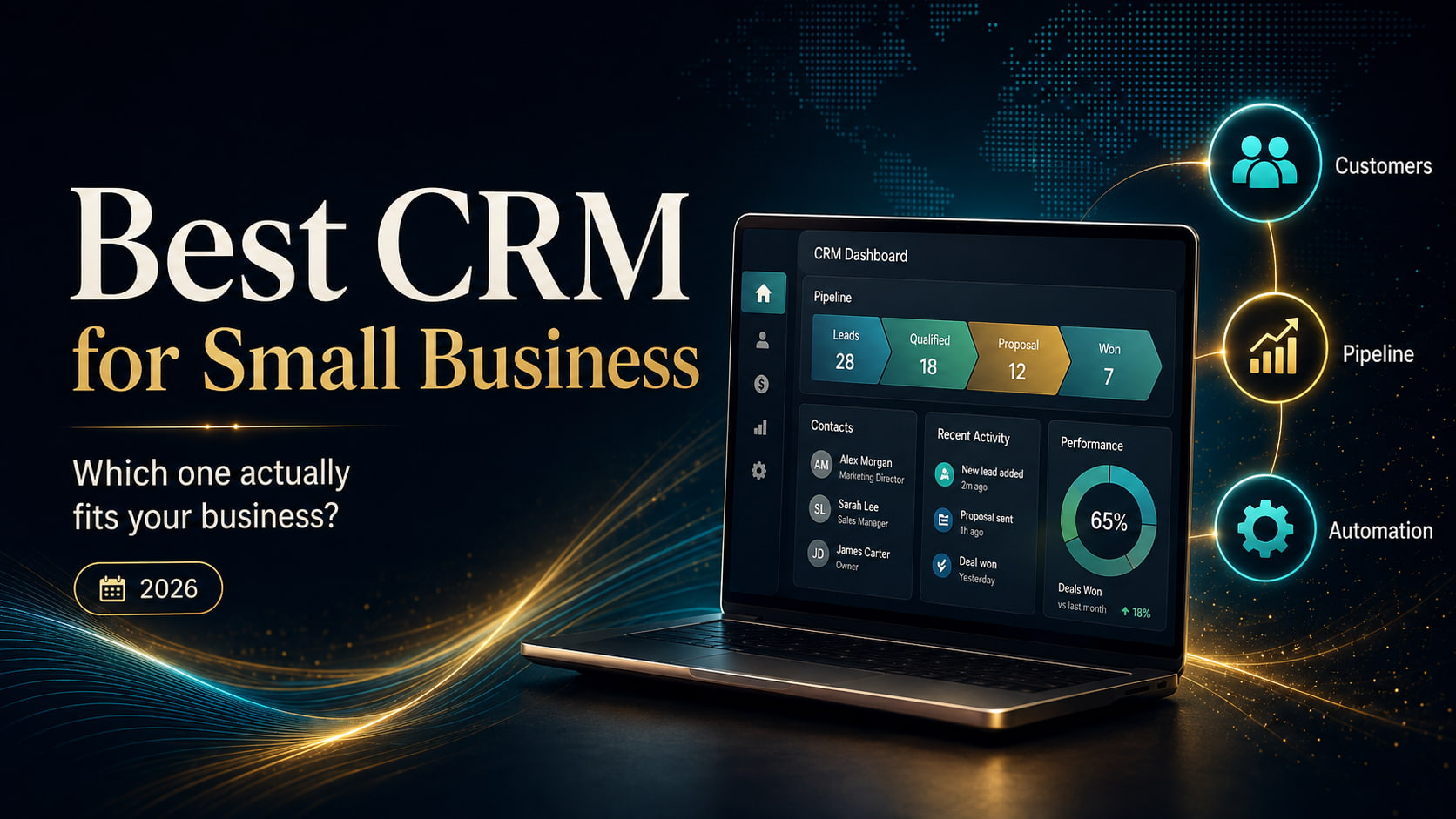
    Best CRM for small business in 2026 comparison.

    A customer sends an enquiry.

    Someone replies.

    A follow-up is supposed to happen on Thursday.

    The prospect asks for a quotation two weeks later, but the person who originally spoke to them is away. Their colleague searches through email, WhatsApp, a spreadsheet and perhaps a notebook trying to reconstruct what happened.

    Another lead has already gone cold because nobody realized a follow-up was overdue.

    At some point, a growing business realizes that remembering customers is no longer the same thing as managing them.

    A CRM—customer relationship management system—is supposed to solve that problem.

    But choosing one introduces another.

    Search for the best CRM for a small business and the same names appear repeatedly: HubSpot, Salesforce, Zoho, Pipedrive, monday, Freshsales and dozens of alternatives. Each promises better organization, more automation, improved follow-up and stronger sales.

    Some start almost free.

    Others can cost thousands of dollars a year.

    Some are deliberately simple. Others can eventually run extraordinarily complicated customer operations.

    So which one should a small business actually choose?

    That is the question we set out to answer.

    And to answer it properly, we first had to stop treating every small business as though it works the same way.


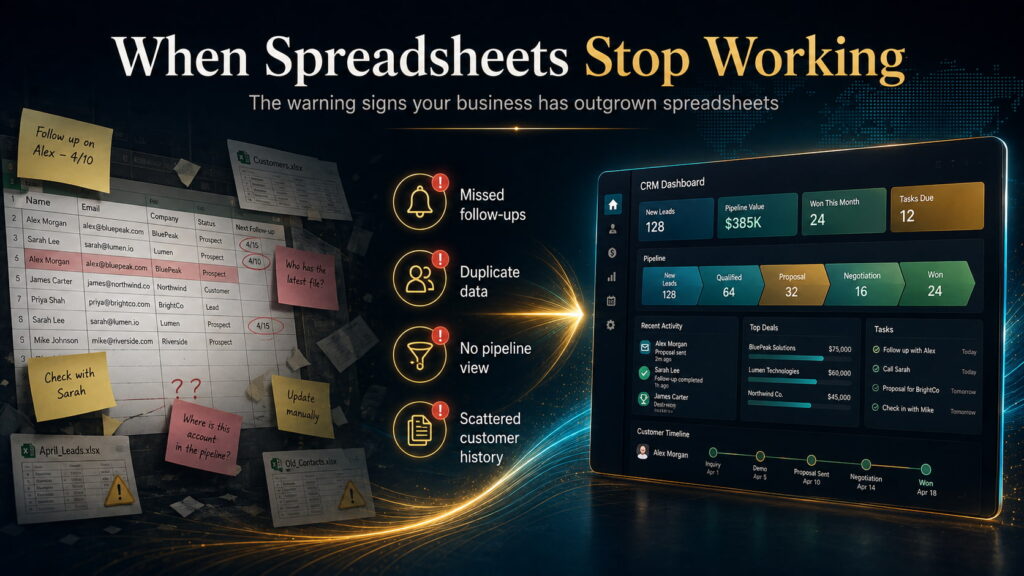
    When spreadsheets stop working

    There is nothing inherently wrong with managing customers in a spreadsheet.

    For a new business with five prospects and one person handling every sale, a CRM may add more administration than value.

    The problem appears when the business becomes harder to hold inside one person’s head.

    Leads arrive from several sources. Multiple employees speak to customers. Quotes need following up. Deals sit at different stages. Previous conversations matter. Management wants to know what is likely to close next month. Nobody is quite certain whether a prospect was forgotten or deliberately abandoned.

    The spreadsheet still contains information, but it no longer reliably controls the process.

    That is the point at which a CRM starts earning its place.

    A useful CRM should answer basic operational questions quickly: Who are we talking to? What has happened so far? What needs to happen next? Who is responsible? Which opportunities are progressing? Which ones are stuck? What is likely to convert?

    Once those questions become difficult to answer, the business has a customer-management problem rather than merely a data-storage problem.

    And that distinction matters when choosing software.


    What are we actually trying to find?

    The obvious question is:

    Which CRM has the most features for the lowest price?

    We think that is the wrong question.

    A CRM can have extraordinary automation, artificial intelligence, forecasting and customization—and still fail if employees find it irritating enough that they stop updating it.

    Another system may be extremely easy to use but become restrictive six months later.

    A third may appear inexpensive at $9 or $14 per user, only for the functionality the business actually needs to sit behind a $39, $90 or $100 plan.

    So our research question became more specific:

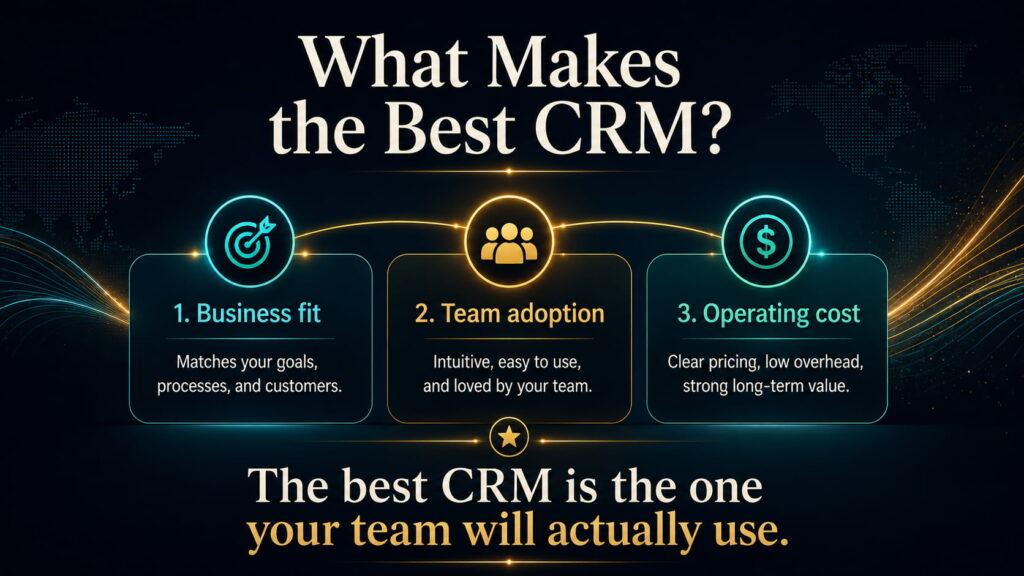
    Which CRM gives a small business the best fit for the way it currently sells, at a realistic operating cost, without creating unnecessary complexity or an obvious problem as the business grows?

    That requires more than comparing features.

    We looked at the current product structure and pricing of Bigin, Freshsales, Pipedrive, Zoho CRM, HubSpot, Salesforce, Attio, monday CRM and Close. We checked vendor documentation for plan limits and capabilities, then compared those claims with independent reviews and substantial user-feedback datasets to identify recurring patterns around usability, limitations, administration and cost.

    We also screened additional products before narrowing the main comparison.

    This is therefore a research comparison—not a claim that we installed nine CRMs into nine identical businesses and ran them for a year.

    Prices were checked in August 2026 and primarily use annual-billing rates in US dollars where available. Pricing, promotions and regional terms can change.


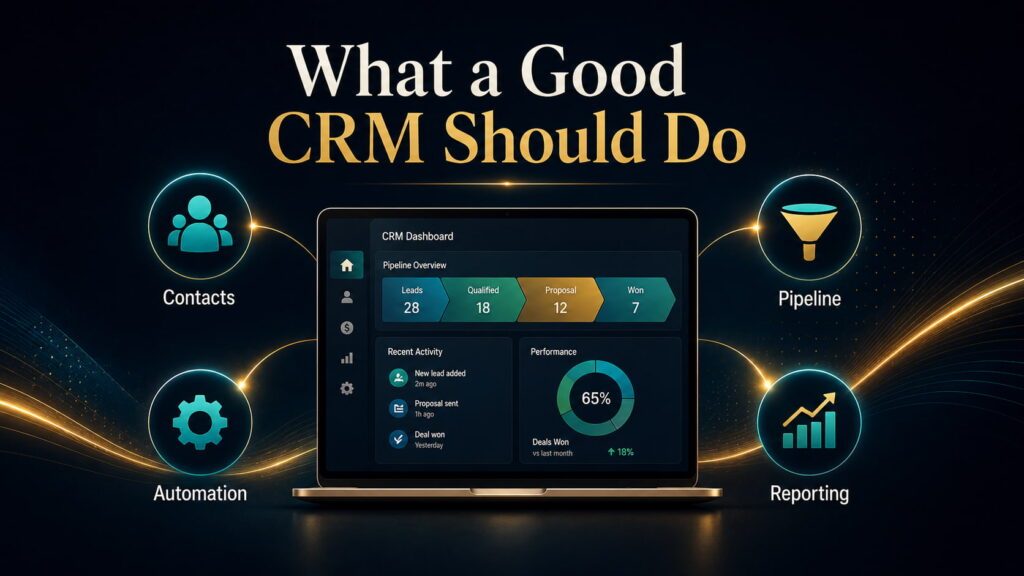
    What should a good CRM actually do?

    Before discussing brands, it helps to strip CRM software back to its purpose.

    A small business normally needs four things from it.

    It needs to organize customers and prospects so information is not fragmented across inboxes and employees.

    It needs to manage a pipeline so the business can see where opportunities are and what should happen next.

    It needs to reduce repetitive work through reminders, workflows, sequences or other useful automation.

    And it needs to make performance visible so decisions are based on what is happening rather than what everybody thinks is happening.

    Everything beyond that can be valuable—but only if the business actually needs it.

    This is where many CRM purchases go wrong.

    Companies buy for the future version of themselves rather than the company they currently operate. They choose the platform with the longest feature list, spend weeks configuring it and then discover that their five-person team mainly wanted a reliable way to track leads and follow-ups.

    The opposite mistake also happens: a business chooses something deliberately basic because it is cheap and discovers shortly afterward that reporting, automation or customization has become too restrictive.

    The best CRM therefore sits somewhere between what you need today and what you can realistically expect to need next.


    The starting price is often the wrong number

    CRM pricing looks straightforward until you inspect what each plan actually contains.

    Pipedrive, for example, starts at $14 per user per month annually. But its $39 Growth plan is where full email synchronization, automations, nurturing sequences, forecasting and meeting scheduling appear. Premium costs $59 and Ultimate $79. Pipedrive also has add-ons and usage top-ups depending on the plan.

    Freshsales takes a different approach. Its $9 Growth plan already includes chat, email, phone, custom fields and basic workflows. Pro costs $39 and adds functions such as scoring, sales sequences and deeper sales controls.

    Close illustrates the problem even more clearly. Its Solo plan is $9 annually and Essentials $35, but automated workflows and the Power Dialer arrive at the $99 Growth level. Calling and SMS are usage-based as well.

    HubSpot has an easy entry point, but Sales Hub Professional currently starts at $90 per sales seat per month annually, plus a required $1,500 one-time onboarding fee. HubSpot Credits can create additional usage costs.

    None of this means those higher-priced plans are bad value.

    It means the useful comparison is not:

    “What does this CRM start at?”

    It is:

    “What will the version that solves my problem actually cost?”


    What five users can cost

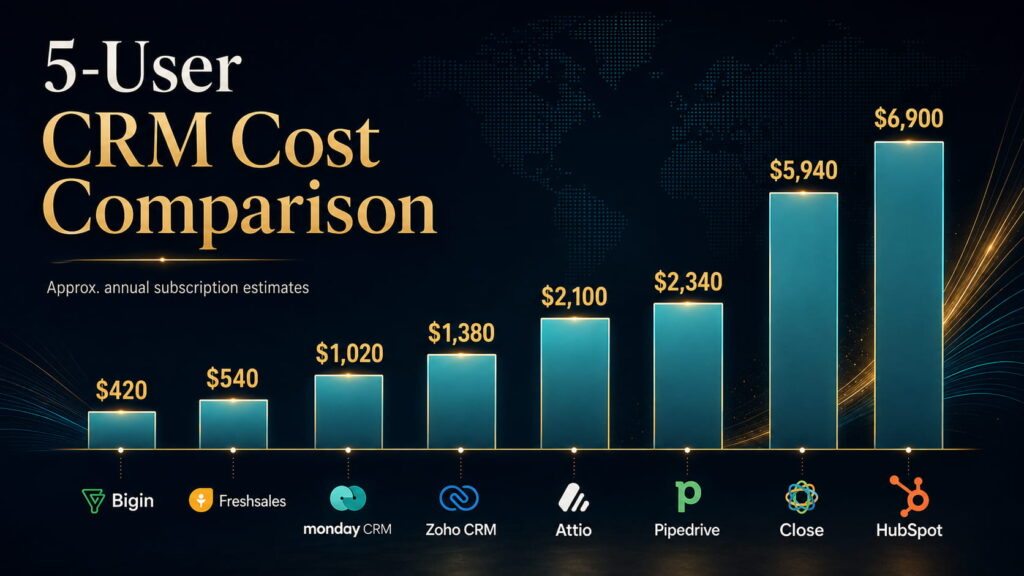
    To make that difference visible, consider a hypothetical five-user business.

    This is not a cheapest-to-most-expensive ranking. We selected a plan that reasonably represents the use case for which each CRM becomes interesting in this comparison.

    CRMIllustrative tierApprox. annual subscription for 5 users
    BiginExpress — $7$420
    FreshsalesGrowth — $9$540
    monday CRMStandard — $17$1,020
    Zoho CRMProfessional — $23$1,380
    AttioPlus — $35$2,100
    PipedriveGrowth — $39$2,340
    CloseGrowth — $99$5,940 + usage
    SalesforcePro Suite — $100$6,000
    HubSpotSales Hub Professional — $90 + onboarding$6,900 first year

    Bigin currently lists Express at $7 annually, Zoho CRM Professional at $23, Attio Plus at $35, monday CRM Standard at $17, Salesforce Pro Suite at $100, and the other prices follow the current official pricing above.

    But this table still does not represent true total ownership cost.

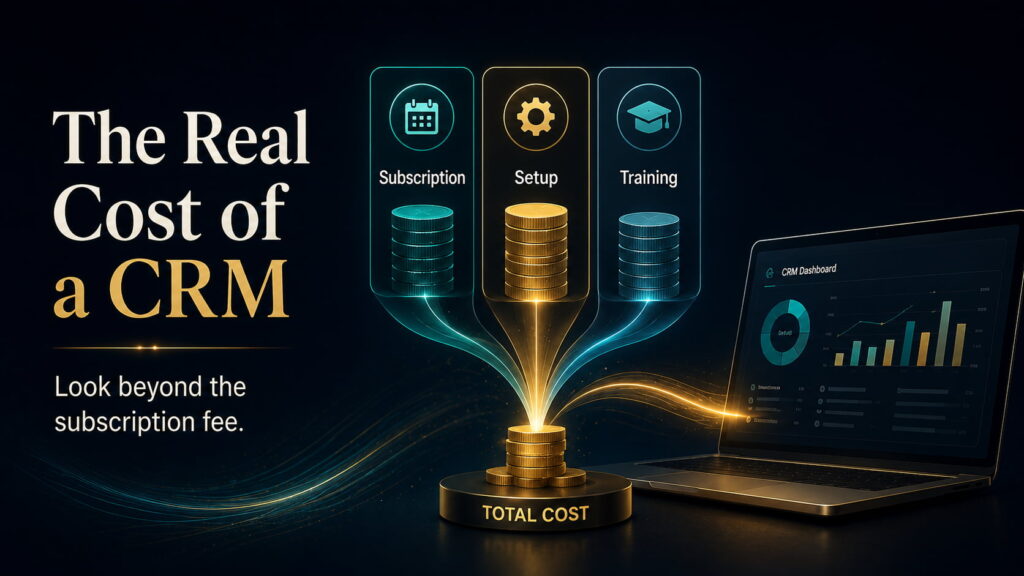
    Implementation, staff training, administration, additional integrations, telephony, marketing contacts, AI credits, data migration and optional add-ons can change the economics substantially.

    A $23 CRM that requires considerably more administration may be more expensive to operate than a $39 CRM your team understands immediately.

    That brings us to the individual products.


    Bigin: how simple can a CRM remain before simplicity becomes a limitation?

    Bigin is Zoho’s deliberately simplified CRM.

    That matters.

    Its $7 Express plan includes multiple pipelines, email and WhatsApp integration, dashboards, automation and a broad range of integrations. Premier costs $12 and expands records, automation and more advanced controls.

    The attraction is not merely the price.

    Bigin is designed around the idea that a small company should be able to start managing customers without first designing a complicated CRM architecture.

    That position is supported by a substantial user base. G2’s current review set contains roughly 800 Bigin reviews, with simplicity, ease of use and intuitive setup recurring prominently; limitations in advanced features, customization and integrations also appear repeatedly.

    That trade-off makes sense.

    A two-person business leaving spreadsheets may gain more from a CRM it can configure this afternoon than from one capable of supporting a multinational sales organization.

    The question is whether the company is likely to outgrow that simplicity quickly.

    Best fit: a microbusiness or very small team buying its first serious CRM.

    Main risk: choosing it when sophisticated reporting, customization or automation is already required.

    Our assessment: Bigin is the strongest first-CRM option in this comparison.


    Freshsales: how much useful CRM can $9 actually buy?

    Freshsales was one of the more interesting results because its lowest paid tier is not merely an entry shell.

    At $9 per user per month annually, Growth includes contact lifecycle management, chat, email, phone, custom fields and basic workflows. Pro costs $39 and introduces scoring, deal insights, territory management and sales sequences.

    That gives a small sales team meaningful functionality before pricing becomes substantial.

    Its user evidence also reinforces the positioning. G2 currently shows more than 1,200 reviews, with usability, setup and automation recurring positively, while advanced reporting and missing higher-level capabilities appear among repeated limitations.

    Freshsales therefore presents a difficult challenge to more famous CRM brands.

    A small company may simply not need to pay significantly more for its first useful automation and communications stack.

    The trade-off appears later, when requirements become more sophisticated.

    Best fit: a small sales team that wants meaningful automation and communications without a large software bill.

    Main risk: assuming the inexpensive Growth plan will also satisfy unusually advanced reporting or customization requirements.

    Our assessment: Freshsales offers the strongest paid value for a typical small sales team.


    Pipedrive: does focus beat breadth?

    Pipedrive approaches the problem differently.

    It is fundamentally a sales CRM, and much of its appeal comes from not pretending otherwise.

    The visual pipeline, activities, next actions and deal movement are central. Growth, at $39 per user annually, adds the email synchronization, automations and sequences that make it a much stronger day-to-day sales system.

    That focused architecture has an important operational consequence: adoption.

    G2’s current dataset includes more than 3,000 Pipedrive reviews. Ease of use, intuitive operation and simplicity occur repeatedly among the positive themes; advanced-feature limitations and price are recurring concerns.

    That is not incidental.

    A CRM only becomes useful when employees consistently record activity, update deals and trust the data inside it.

    A feature-rich system that salespeople avoid can be economically worse than a narrower system they reliably use.

    Where Pipedrive becomes less convincing is outside the sales process. Broader marketing, project delivery and other functions can require add-ons or separate systems. Projects, for example, remains an add-on on Lite and Growth while being included at Premium and Ultimate.

    Best fit: a conventional sales-led small business that values pipeline clarity and adoption.

    Main risk: expecting the CRM to become an all-in-one operating system for marketing, support and delivery.

    Our assessment: Pipedrive is the strongest default sales-first CRM in the group.


    Zoho CRM: when does capability become complexity?

    Zoho CRM takes almost the opposite approach.

    Its pricing remains aggressive while offering a very broad capability surface.

    Standard is currently $14 per user per month annually, Professional $23, Enterprise $40 and Ultimate $52. Professional and the higher tiers progressively add deeper process management, automation and customization.

    For a company willing to configure its CRM carefully, that is difficult to ignore.

    The potential hidden cost is not necessarily another subscription.

    It is time.

    More configurable systems require decisions: fields, stages, rules, permissions, automation logic, reporting structures and responsibility for maintaining all of it.

    That is why two companies can have completely different experiences with the same CRM. One uses a straightforward setup and finds Zoho economical and powerful. Another attempts to exploit every possibility and creates an administration burden.

    Best fit: a cost-conscious growing company that genuinely needs greater customization and automation.

    Main risk: buying the features because they are available rather than because somebody has a clear plan for operating them.

    Our assessment: Zoho CRM provides the strongest capability-per-dollar among the more configurable traditional CRMs.


    HubSpot: are you buying a CRM or building a growth platform?

    HubSpot becomes easier to understand when it is not judged purely as a sales pipeline.

    Its advantage is the relationship between CRM, marketing, content, forms, customer service and the wider customer journey.

    For an inbound-led business, that can matter enormously.

    A visitor discovers an article, completes a form, enters the CRM, receives marketing communication, books a meeting and eventually becomes a sales opportunity. Keeping those interactions inside a connected platform can be more valuable than choosing the cheapest standalone sales CRM.

    The difficulty is the cost curve.

    Professional currently starts at $90 per sales seat per month annually and requires $1,500 in onboarding. Enterprise begins at $150. HubSpot is also increasingly using credits for AI-driven capabilities.

    The mistake would therefore be evaluating HubSpot only from its free or Starter experience.

    A business considering it should model the version it could plausibly need in 12–24 months.

    Best fit: a company where inbound marketing and sales are genuinely connected.

    Main risk: adopting the ecosystem cheaply and discovering later that the functionality that justified the platform sits behind a much more expensive tier.

    Our assessment: HubSpot is the strongest option here for an inbound-led sales-and-marketing operation, not the default recommendation for every small business.


    Salesforce: is enterprise-level runway now relevant to small businesses?

    Salesforce used to be easy to dismiss from a small-business comparison.

    That is no longer sensible.

    Starter Suite now costs $25 per user per month and includes lead, account, contact and opportunity management, lead routing, sales flows and email-related functionality. Pro Suite costs $100 annually and adds significantly greater customization, automation, quoting and forecasting.

    That creates a genuine entry path for smaller companies that expect their operating complexity to increase.

    But the fundamental Salesforce trade-off has not disappeared.

    Its value rises as the company needs more customization, integrations, controls and process depth.

    If those needs never materialize, the same flexibility can become unnecessary complexity.

    There is little value in buying a system capable of supporting tomorrow’s 100-person revenue operation when today’s six-person team cannot comfortably maintain it.

    Best fit: a growing company with credible—not hypothetical—reasons to expect substantial process and integration complexity.

    Main risk: paying today’s complexity cost for future requirements that may never exist.

    Our assessment: Salesforce provides the greatest long-term extensibility in this comparison.


    Attio: what if a normal CRM structure is the problem?

    Traditional CRMs generally assume that customer relationships can be organized around familiar objects such as contacts, companies and deals.

    That works for many businesses.

    It does not work equally well for all of them.

    Attio’s attraction is its more flexible data model and modern approach to structuring relationships.

    Its Free plan supports up to three seats. Plus costs $35 per user per month annually and Pro $79. The higher tiers expand objects, reporting, permissions, sequences and automation, while Attio also uses seat and workspace credits for parts of its AI and automation system.

    That makes it particularly interesting for startups, partnership-led organizations and companies with relationship structures that do not naturally fit a classic pipeline.

    But flexibility only has value when the business needs flexibility.

    Choosing Attio because it looks modern is not a business case.

    Best fit: a startup or organization with unconventional relationship structures or multiple go-to-market motions.

    Main risk: paying for structural flexibility when a conventional sales CRM would be simpler.

    Our assessment: Attio is the strongest modern flexible CRM in the group, although its evidence base is younger than the established platforms.


    monday CRM: should CRM and operations live together?

    Some businesses do not really have a CRM problem in isolation.

    They have a workflow problem.

    A deal is sold and then becomes a project. Tasks need assigning. Work moves across departments. The boundary between customer management and operational management is less clear.

    That is where monday CRM becomes interesting.

    Its Basic plan currently costs $12 per seat monthly on annual billing, Standard $17 and Pro $28, with plans beginning at three seats. Standard includes centralized communications and 250 custom automations per month, while Pro significantly expands automation capacity and sales functionality.

    Its strength is configurability.

    Its weakness comes from the same place.

    A highly flexible environment allows a company to shape the system around its process, but somebody first has to decide what that process should be.

    Best fit: businesses wanting CRM and broader workflow management in a configurable environment.

    Main risk: overbuilding something the sales team finds harder to use than a conventional CRM.

    Our assessment: monday CRM is the strongest CRM/work-management hybrid in the comparison.


    Close: what if selling is mostly outbound communication?

    Close is easier to judge because its intended use is unusually clear.

    It is designed around sales teams that spend a large part of the day contacting prospects.

    Email, calling and SMS sit directly inside the CRM.

    Essentials costs $35 per user per month annually and includes those communication tools. Growth costs $99 and adds automated workflows, Power Dialer, bulk email and additional AI capacity. Calling and SMS remain usage-based.

    That creates an important pricing lesson.

    For a business that rarely makes outbound calls, Close at $99 can look expensive.

    For an outbound team replacing several communication and automation tools, comparing that $99 only with a cheaper CRM seat is misleading.

    The value depends on whether the business actually operates the way Close expects it to.

    Best fit: a calling-, email- and SMS-heavy outbound sales organization.

    Main risk: buying a communications-first platform when outbound communication is not central to the sales model.

    Our assessment: Close is the clearest specialist winner for outbound sales.


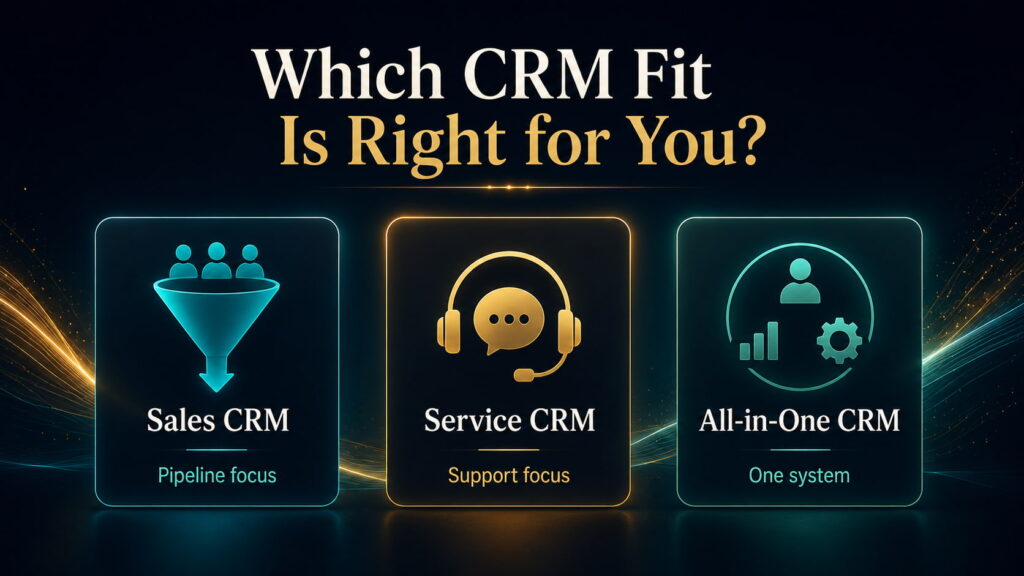
    Start with how you sell

    After comparing the products, the decision becomes much simpler when the software names are temporarily removed.

    If your business is moving out of spreadsheets and needs basic discipline without a large learning curve, start by investigating Bigin.

    If you have a small sales team and price matters heavily, Freshsales deserves serious attention.

    If the central requirement is a focused sales pipeline that representatives are likely to adopt quickly, Pipedrive is the stronger starting point.

    If you want extensive capability without enterprise-level pricing and are prepared to configure the system, investigate Zoho CRM.

    If customers are primarily generated through inbound marketing and you want marketing and sales tightly connected, HubSpot becomes much more compelling.

    If your organization genuinely expects complex processes and deep integrations, Salesforce becomes a rational candidate rather than automatic overkill.

    If a traditional CRM data model feels restrictive, examine Attio.

    If the customer journey needs to connect directly with flexible operational workflows, monday CRM deserves consideration.

    And if the sales process revolves around frequent outbound calling, email and SMS, Close should be high on the shortlist.

    Only after identifying that operating model should a business begin comparing individual feature checklists.


    Choosing the CRM is only part of the job

    A good CRM can still fail badly.

    The usual failure is not that the database stops functioning.

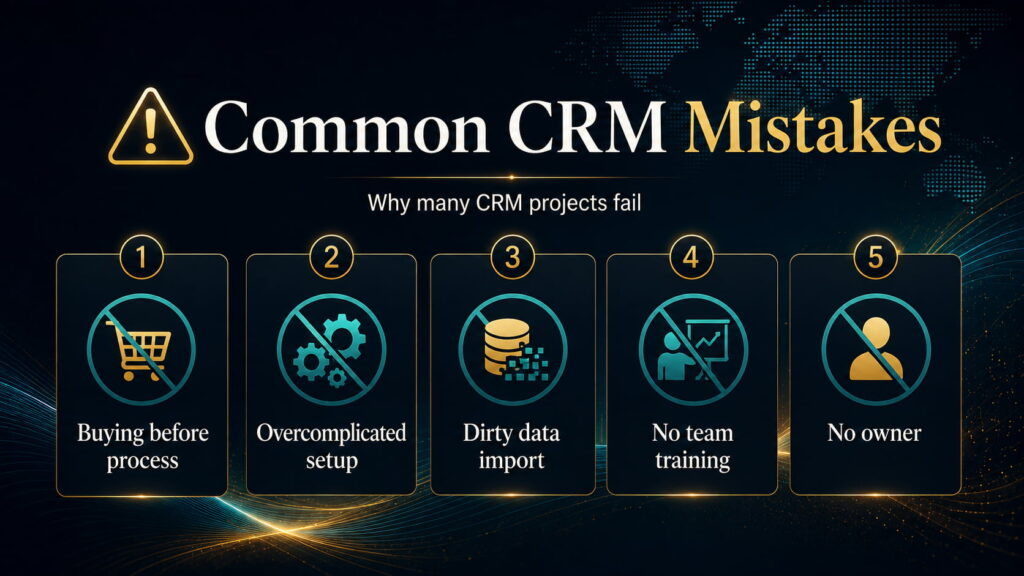
    The business implements too much too quickly, imports poor-quality data, gives nobody clear ownership of the system, creates unnecessary fields and stages, and then wonders why employees return to spreadsheets and private notes.

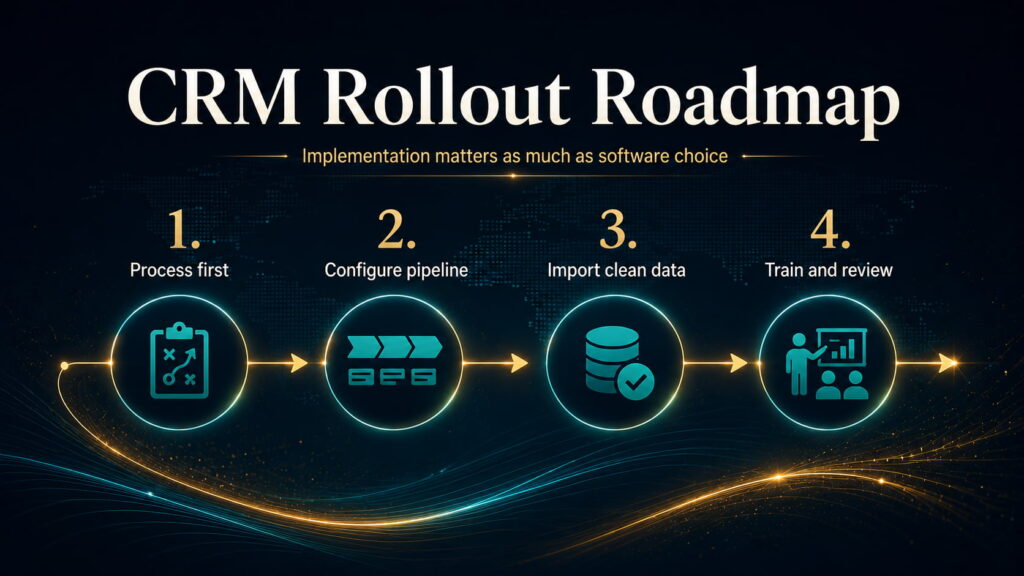
    Implementation should begin with the business process, not the software.

    Define how a lead becomes a customer.

    Clean the information being imported.

    Build only the pipeline and automation needed to support that process.

    Give responsibility for the CRM to someone.

    Then train the people expected to use it and watch where adoption breaks.

    The goal is not to create an impressive CRM.

    The goal is to create a reliable operating habit.


    What CRM comparisons often leave out

    Subscription cost is only the visible part of CRM economics.

    The more useful equation is:

    subscription + add-ons + communications + AI/automation usage + implementation + training + administration + integrations + migration risk = real operating cost

    The proportions vary enormously.

    HubSpot has explicit onboarding costs at Professional and Enterprise. Close charges separately for telephony and SMS usage. Attio has an additional credit economy. Pipedrive can involve add-ons and top-ups. monday has automation limits by tier.

    There is another cost that rarely appears on a pricing page:

    poor adoption.

    If half the team stops entering activities, managers stop trusting the pipeline.

    Once managers stop trusting the CRM, they request spreadsheets and manual reports.

    The organization then pays for the CRM while recreating the system it was supposed to replace.

    Ease of use is therefore not merely aesthetic.

    It can have direct financial value.


    Other CRMs worth knowing about

    Our wider screening did not begin with nine products.

    Platforms including Vtiger, Flowlu and Salesmate also deserve attention for particular businesses.

    Vtiger is especially interesting where CRM needs to sit closer to help desk, campaigns and inventory-related operations.

    Flowlu can make sense for service businesses where the customer journey moves from sale into project delivery, time tracking and billing.

    Salesmate remains a credible sales and communications alternative.

    They did not displace the main candidates strongly enough across our chosen use cases to justify turning this into a 15-product catalogue.

    The objective is not to mention every CRM.

    It is to reduce the decision.


    So which CRM is actually best for a small business?

    After the research, there is no defensible single answer for every small company.

    But there are clear answers once the business itself is defined.

    For a microbusiness buying its first CRM, Bigin is our strongest choice.

    For a small team seeking exceptional paid value, Freshsales is difficult to beat.

    For a conventional sales-led company, Pipedrive is the strongest default because focus and adoption matter.

    For deeper customization at comparatively low software cost, Zoho CRM is extremely compelling.

    For an inbound-led sales and marketing operation, HubSpot has the strongest structural advantage.

    For a company with genuine reasons to expect extensive future complexity, Salesforce provides the greatest runway.

    For unconventional relationship models, Attio offers the most interesting modern alternative.

    For businesses that want CRM and flexible workflow management together, monday CRM is the better fit.

    And for communication-heavy outbound sales, Close is the clearest specialist.

    The mistake is choosing among those products before understanding the business problem.

    The longest feature list does not automatically make the best CRM.

    The cheapest plan does not automatically produce the lowest operating cost.

    And the platform with the greatest future capability is not necessarily the system your company needs today.

    The better question is the one we should have asked from the beginning:

    How does your business actually sell, what needs to happen reliably after a lead appears, and how much complexity are you prepared to operate to make that happen?

    Once those answers are clear, choosing the CRM becomes considerably easier.