

A customer sends your business a WhatsApp message.
They ask about a product. Someone replies. A quotation is sent. The customer says they will make a decision next week.
Three days later, another enquiry arrives.
Then another.
One salesperson remembers to follow up. Another assumes somebody else has already replied. A customer waiting for a revised quotation slowly disappears underneath newer chats.
Two months later, an old prospect returns, but the employee who originally handled them is away.
Nothing is technically wrong with WhatsApp.
Every conversation is still there.
The problem is that the business is beginning to depend on people remembering what those conversations mean.
Who owns this lead?
What was promised?
What happens next?
When should somebody follow up?
How much is the opportunity worth?
At some point, a business that sells through WhatsApp has to ask:
Are our sales beginning to outgrow the chat?
The answer is not simply “yes” because the company has become bigger.
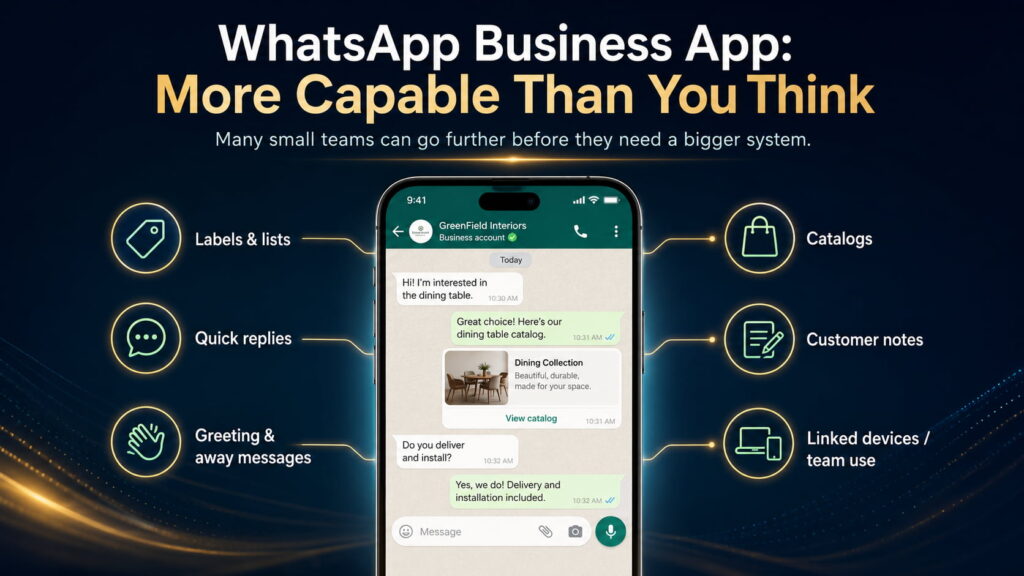
WhatsApp Business itself has become considerably more capable. It now encourages businesses to use Lists to organize customers around stages such as New inquiry, Pending info, Order in progress, Payment pending, Completed and Follow up. It also includes quick replies, greeting and away messages, catalogs and other tools designed specifically for small-business conversations.
So the real question is not when to abandon WhatsApp.
It is:
When does managing the sale require more structure than the conversation can reliably carry?
WhatsApp can take a small business surprisingly far
A lot of advice about “graduating from WhatsApp” starts too early.
If a small team occasionally loses track of a follow-up, the first response should not necessarily be:
Buy a CRM.
It may be:
Use WhatsApp Business properly.
WhatsApp recommends organizing chats into Lists that reflect the customer journey and maintaining a daily routine for reviewing and labeling open conversations. Quick replies can remove repetitive typing, while greeting and away messages help maintain consistent responses.
The Business app also supports up to four linked devices on one number, allowing several team members to view and answer conversations. For eligible businesses, Meta Verified adds multi-agent functionality including chat assignment.
And Meta Business Suite adds another layer.
Its Inbox can bring WhatsApp, Instagram and Messenger conversations into one place. Teams can filter conversations requiring follow-up, see who a conversation is assigned to, add customer details and private notes, use labels and configure simple automations.
For many small businesses, that may be enough.
The cheapest software problem is often the one you can solve with tools you already have.
There is no magic number of messages where WhatsApp becomes inadequate
It would be convenient to say:
50 enquiries a day = time for a CRM.
Or:
Five salespeople = WhatsApp is no longer enough.
The research does not support a universal threshold.
Consider a restaurant processing hundreds of WhatsApp conversations each week:
menu → order → payment → delivery → complete
It may have little need for opportunity values, closing probabilities or pipeline forecasts.
Now consider a consultancy with only 15 serious prospects.
Each opportunity might take months to close and be worth tens of thousands of dollars.
Management may need to know:
- who owns each opportunity;
- what stage it has reached;
- proposal value;
- next meeting;
- expected close date;
- objections;
- source;
- probability of closing.
The consultancy may need a structured sales system far earlier despite receiving dramatically fewer messages.
The complexity of the sale matters more than the number of chats.
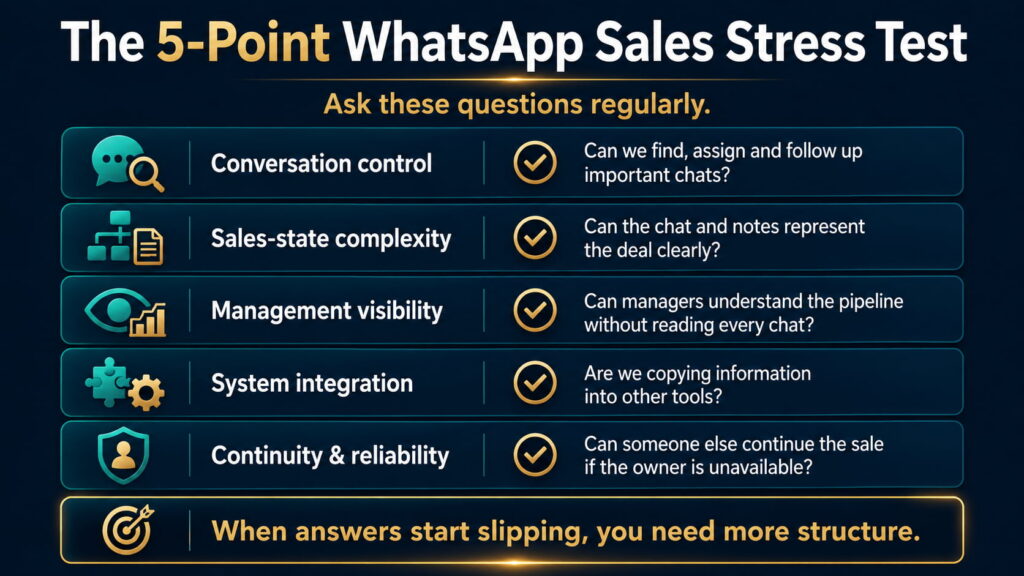
Five questions reveal whether the system is starting to strain
Instead of counting messages, test the sales process itself.
1. Conversation control
Can we reliably find, assign and follow up every important conversation?
If Lists, follow-up routines and assignment solve this, WhatsApp may still be perfectly adequate.
2. Sales-state complexity
Can the conversation, Lists and notes represent everything we need to know about the opportunity?
If the business increasingly needs structured fields such as deal value, stage, expected close and next activity, the requirement is changing.
3. Management visibility
Can a manager understand what is happening across all active opportunities without reading individual conversations?
If answering a basic question such as “What could close this month?” requires opening 40 chats, the inbox is being asked to do a job it was not designed to do efficiently.
4. System integration
Are employees repeatedly copying information from WhatsApp into spreadsheets, invoicing systems, order systems or another database?
Manual duplication is often a sign that another layer should be connected rather than maintained separately.
5. Continuity
If the salesperson handling the account disappeared tomorrow, could someone else continue correctly?
If the real sales state exists partly in the conversation and partly in one person’s memory, the process has become fragile.
A business does not need to fail every test before acting.
But the more answers become uncomfortable, the stronger the case for additional structure.
A conversation and a sales record do different jobs
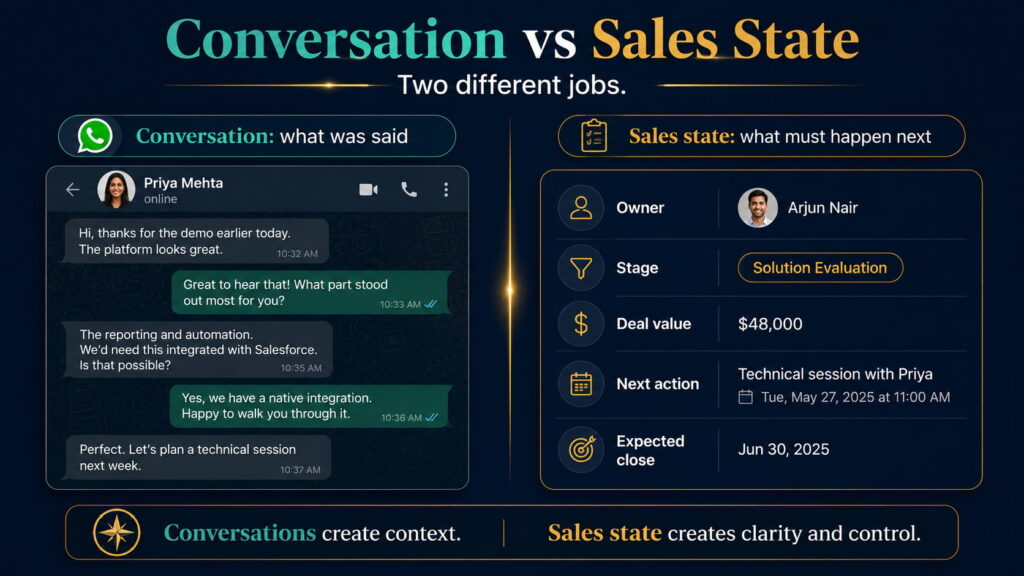
Consider this WhatsApp exchange:
“Thanks. I’ve sent the revised quotation. Let’s speak Thursday.”
A person reading the chat understands what happened.
But management may eventually need something different:
Owner: Mary
Stage: Proposal
Deal value: $12,000
Next action: Follow up Thursday
Expected close: September
Lead source: Website
Both records describe the same sale.
They are not interchangeable.
The conversation provides context.
Structured sales data provides control and visibility.
With structured information, a business can answer questions such as:
Which opportunities have no next action?
How much pipeline does each salesperson hold?
Which lead source produces the most valuable opportunities?
How many proposals have been waiting more than two weeks?
What might close next month?
That is where a CRM—or another structured sales system—starts creating value.
Not because WhatsApp has somehow become bad.
Because the business now needs a different kind of information.
Add the smallest layer that solves the problem
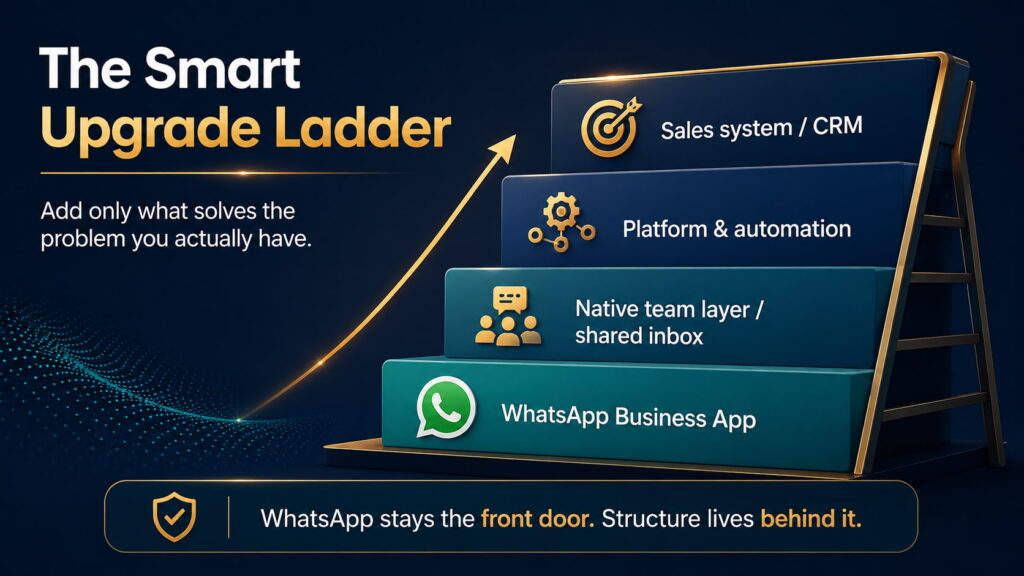
The sensible upgrade path is not:
WhatsApp → giant CRM.
It is gradual.
Start with WhatsApp Business
Use Lists, notes, quick replies and disciplined follow-up.
If that solves the problem, stop.
Add native team tools when coordination becomes difficult
If several people need to handle one number, linked devices, Meta Business Suite and eligible Meta Verified multi-agent tools may solve the problem without introducing another platform.
Add the WhatsApp Business Platform when integration or automation becomes necessary
If the business needs deeper routing, CRM integration, automation or a larger operational layer, WhatsApp says businesses can connect the Business app to the Business Platform using the same number while retaining the app, number and chat history.
Add a structured sales system when the sale itself needs one
If management needs deal stages, values, pipeline reporting, attribution, forecasting or richer customer history, a CRM or equivalent system of record becomes much easier to justify.
The principle is simple:
Add only the layer that solves the problem you actually have.
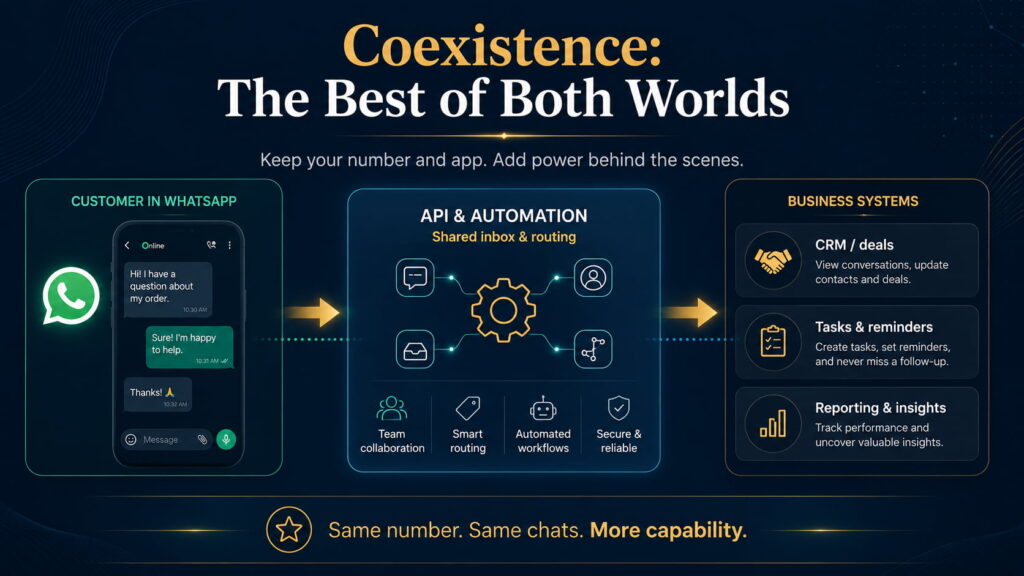
WhatsApp can remain the front door
One of the more important changes in WhatsApp’s current architecture is that improving internal systems does not necessarily mean forcing customers to change how they communicate.
That is a mistake businesses should avoid.
Customers may already prefer WhatsApp.
Employees may already understand it.
The telephone number may already be advertised everywhere.
The objective should therefore often be:
keep WhatsApp in front and put better systems behind it.
A customer sends the same WhatsApp message as before.
Behind the scenes, however:
the enquiry can be routed → ownership recorded → customer information synchronized → a next action created → pipeline information updated → management reporting improved.
From the customer’s perspective, nothing became more complicated.
From the company’s perspective, the sale became considerably more manageable.
AI raises the WhatsApp ceiling even further
Meta is also adding more AI directly to business messaging.
Meta Business Agent is designed to answer customer questions, provide recommendations and support commerce, while Meta says more than one million businesses were already using its Business Agent by June 2026. Its wider Business Agent Platform is also designed to connect with companies’ existing systems.
That can remove a substantial amount of conversational workload.
But it does not eliminate the difference between:
handling the customer conversation
and
managing the commercial state of the business.
An AI agent may be able to answer:
“Do you deliver?”
It might qualify an enquiry or help a customer choose a product.
Management may still need to ask:
“What is the total value of qualified opportunities expected to close next month?”
Those are different problems.
AI can raise the conversational ceiling without making structured business systems unnecessary.
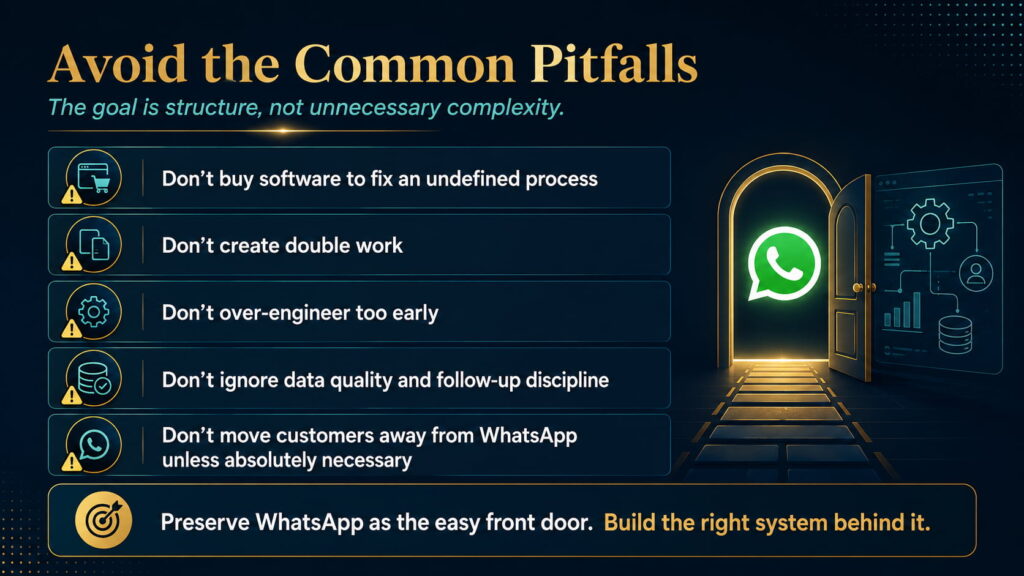
Do not replace WhatsApp chaos with CRM chaos
Adding another system can also make things worse.
Imagine salespeople still speaking to customers on WhatsApp but now being required to manually copy every interaction, contact detail, next action and note into a CRM.
The business has not necessarily reduced work.
It may simply have created two systems employees must maintain.
Soon:
some information is in WhatsApp;
some is in the CRM;
some is in a spreadsheet;
and the salesperson remembers the rest.
That can be worse than the original problem.
A better architecture should capture information automatically wherever practical.
The salesperson should ideally add only the information the system cannot reliably infer—perhaps deal value, stage, expected close or an important commercial judgment.
Structure should reduce dependence on manual administration, not create more of it.
The cost of upgrading is only half the equation
Moving to the WhatsApp Business Platform can introduce messaging charges.
WhatsApp’s current pricing model charges businesses per delivered message, with rates depending on the recipient market and message category. Service messages are free, as are utility messages sent in response to users. When a customer messages a business, a 24-hour customer-service window opens in which service responses are free. Certain click-to-WhatsApp entry points can also create a 72-hour period in which messages are not charged.
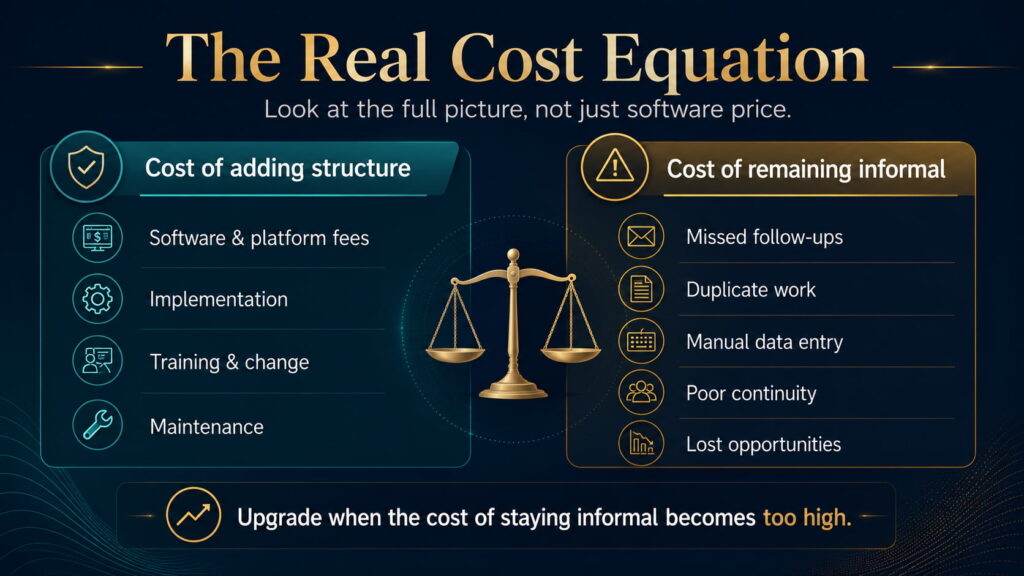
Additional systems may then introduce:
- software subscriptions;
- implementation;
- integrations;
- training;
- maintenance;
- automation or AI usage charges.
But comparing those costs only against free WhatsApp is misleading.
Remaining informal also has potential costs:
- missed follow-ups;
- lost opportunities;
- duplicate replies;
- repeated data entry;
- poor continuity;
- weak pipeline visibility.
The correct question is therefore not:
How much does the software cost?
It is:
Has the cost of running sales informally become greater than the cost of adding structure?
Some businesses may never need a conventional CRM
That is entirely possible.
A salon might operate:
enquiry → booking → reminder → appointment
A retailer:
question → order → payment → delivery
If WhatsApp Business and simple automation handle those processes reliably, adding a conventional sales CRM may create administration without creating enough additional value.
Growth does not automatically require more software.
Conversely, a tiny company selling complicated high-value deals may need structured pipeline management almost immediately.
The right system depends on how the business sells.
So, are your sales outgrowing WhatsApp?
Not because you received your hundredth message.
Not because a second employee joined the sales team.
And not because somebody said a serious company needs a CRM.
Your sales are beginning to outgrow WhatsApp when the information required to manage them can no longer be represented, maintained and understood reliably using the conversation and the native organizational tools available to you.
Until then, organizing WhatsApp better may be the correct answer.
After that, add the smallest missing layer.
If teamwork is broken, improve teamwork.
If automation or integration is missing, investigate the Business Platform.
If structured opportunities, pipeline reporting and forecasting have become necessary, add a sales system behind WhatsApp.
But wherever possible, keep the customer experience simple.
Your customer does not care how sophisticated your internal technology stack is.
They care that somebody remembers what was promised, follows up when expected and moves the conversation forward.
The real tipping point is therefore not:
“Are we too big for WhatsApp?”
It is:
“Has managing the sale become more complex than the conversation can reliably carry?”
When the answer becomes yes, it is time to add structure—not necessarily to replace WhatsApp.