
You open your bank statement and start adding them up.
Twenty dollars for one AI assistant.
Thirty dollars for an image generator.
Another subscription for video.
Another for voice.
Another for music.
Then editing.
Design.
Upscaling.
Stock assets.
Maybe a second AI assistant because it does one particular job better than the first.
None of the individual payments looks especially alarming.
Together, they can quietly become a substantial production expense.
The problem is becoming harder to see because creator tools are no longer staying inside neat categories. Video platforms generate images. Image platforms generate video. Voice platforms create music and sound effects. Design platforms include AI models. General AI assistants increasingly cover research, writing, images and parts of production planning.
So the question is no longer simply:
Which creator tools are best?
It is:
Which of them are actually doing enough unique work to deserve another recurring payment?
Adobe’s 2026 creator research found that 75% of creators using creative AI now consider it integrated or essential to their workflow. Yet 57% still said AI-generated output usually required moderate or extensive editing before it was ready to publish.
AI is becoming normal.
That does not mean every AI tool deserves a permanent subscription.

Creator-tool categories are starting to collapse
A few years ago, the creator stack was relatively easy to understand.
One tool wrote.
Another generated images.
Another made video.
Another created narration.
Another edited everything together.
Those boundaries are disappearing.
Platforms such as Runway, Adobe Firefly and Freepik increasingly provide access to several creative capabilities—and sometimes several underlying models—inside one subscription.
ElevenLabs has expanded beyond voice into music, sound effects, transcription and other creative tools.
Canva increasingly combines design, stock, AI generation and publishing tools.
General AI subscriptions are also broadening.
That creates capability overlap.
A creator can easily pay three different companies for image generation, two for video and several for AI assistance without consciously deciding that each subscription still solves a different problem.
But overlap alone is not enough reason to cancel something.
Overlap does not always mean waste
Suppose you already have image generation inside three subscriptions.
Does that mean a dedicated image generator should go?
Not necessarily.
Perhaps the specialist produces the visual style that defines your channel.
Perhaps it reaches a usable result in two generations instead of eight.
Perhaps its privacy controls matter.
Perhaps it gives you a workflow that saves an hour on every project.
The correct question is not:
Does something else technically have this feature?
It is:
Can something else replace the result I actually care about?
That distinction matters because two products can both advertise AI video generation while differing dramatically in:
- motion quality;
- character consistency;
- control;
- generation speed;
- failure rate;
- workflow;
- export quality;
- real cost per usable clip.
Feature overlap is not the same as workflow redundancy.
Start with what you actually publish
A creator stack should not begin with a shopping list of software.
Begin with the finished content.
Take a normal publishing cycle and write down what genuinely has to happen.
A faceless YouTube channel might need:
research → script → visuals → narration → music → edit → thumbnail → publish
A talking-head creator might need:
research → outline → filming → editing → captions → thumbnail
An AI filmmaker might need:
story → reference images → generation → animation → voice → sound → upscaling → edit
These workflows are completely different.
So a universal “best creator stack” makes little sense.
The first question is:
Which capabilities appear in most of the content I actually publish?
The second is:
Which of those capabilities genuinely require paid software?
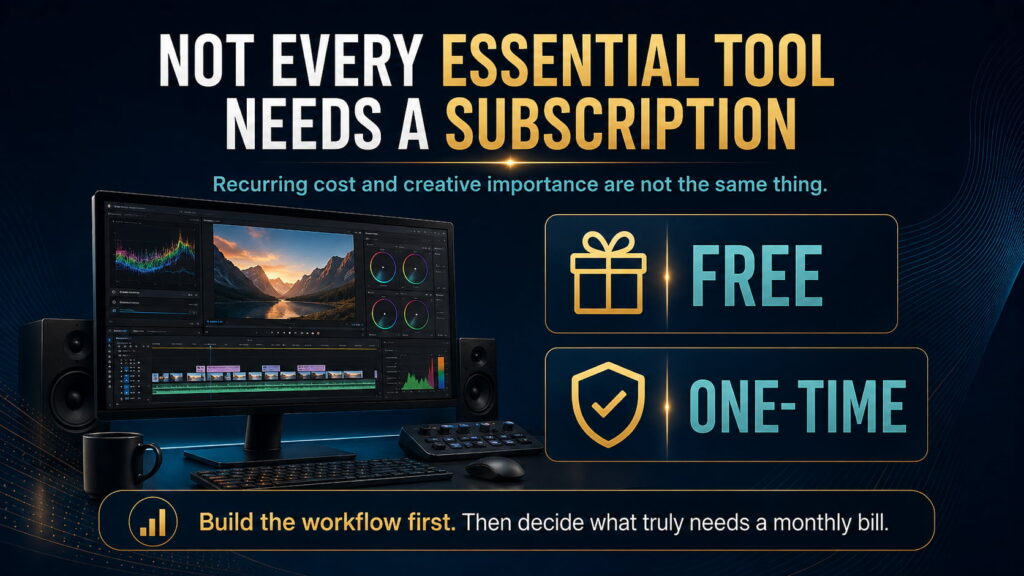
Not every essential tool needs a subscription
Editing is a good example.
It may be one of the most important parts of the entire creator workflow. Adobe’s creator research suggests that much AI output still requires meaningful human refinement before publication.
But essential does not automatically mean subscription.
DaVinci Resolve, for example, offers an extremely capable free version covering editing, color, effects, motion graphics and audio. Resolve Studio is available as a one-time purchase rather than a recurring monthly fee.
The same principle applies elsewhere.
A creator can have an essential capability that is:
free,
owned outright,
or included inside another subscription.
Your workflow might require ten important capabilities without requiring ten recurring bills.
A smart creator stack has four different roles
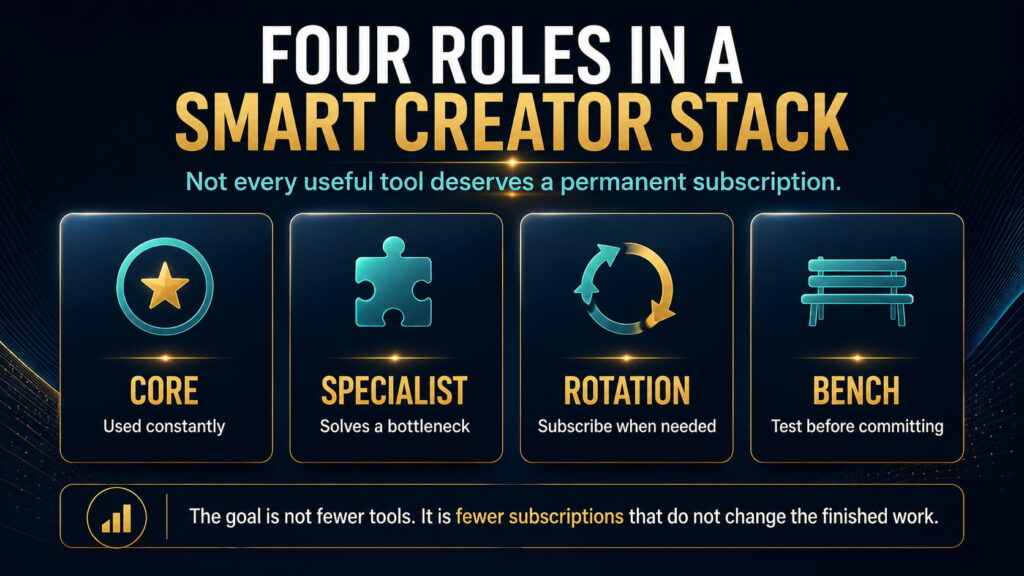
Instead of treating every useful tool as permanent, divide the stack into four roles.
Core
These appear in most production cycles.
Removing one would materially slow the workflow or reduce the quality of what gets published.
For one creator, that might be an editor and a general AI assistant.
For another, narration may be Core.
Core tools are the strongest candidates for permanent subscriptions.
Specialist
A specialist solves one recurring bottleneck unusually well.
Perhaps it produces your distinctive images.
Perhaps its voices are noticeably better.
Perhaps its video model delivers far more usable shots than your alternatives.
A specialist earns its subscription when the advantage survives into the published work.
Rotation
Some tools are extremely useful—but only for certain projects.
If you spend six weeks creating an AI-heavy documentary, a high-volume video subscription might be invaluable.
If the next three months are mostly interviews, keeping that same plan active may make little sense.
Rotation means:
subscribe → produce → export what you need → downgrade or cancel
rather than converting every useful service into permanent overhead.
Bench
This is where experimentation belongs.
Free tiers.
Trials.
Pay-as-you-go credits.
New models.
Interesting tools you are still testing.
Creators should experiment.
But experimentation does not require twelve simultaneous recurring payments.
A tool should leave the Bench only after repeated use proves that it belongs somewhere else.
Before paying, ask seven questions
A good tool still needs to earn its recurring cost.
Frequency
Do I use this in most real production cycles?
If not, Rotation may be more appropriate than Core.
Uniqueness
What does it materially better than everything else I already pay for?
“Better AI” is too vague.
“Produces the visual style used in almost every thumbnail” is meaningful.
Published impact
Can the audience actually see or hear the difference?
A technical improvement that disappears after editing, compression and publication may not justify another subscription.
Economics
Does the value created exceed the real cost?
That means more than the monthly fee.
Include credits, top-ups, failed generations, learning time and workflow friction.
Rights
Do I need the paid plan for commercial use, privacy, exports or licensing?
Sometimes this alone justifies payment.
Replaceability
Ask:
If I cancel this tomorrow, can something already in my stack perform 80–90% of the job well enough?
If yes, the subscription needs a strong reason to survive.
Exit friction
Before cancelling, ask what disappears.
Unused credits?
Private work?
Commercial rights?
Custom voices?
Stored projects?
Trained assets?
Cancellation can be correct while still being expensive if handled badly.

Credits are not the real cost
Creator platforms increasingly use their own internal currencies.
One service offers 625 credits.
Another offers tens of thousands.
A third offers hundreds of thousands.
Those numbers are largely meaningless across platforms.
A credit has no universal value.
Even within one service, different models may consume credits at radically different rates.
So don’t compare:
credits per month.
Compare:
usable output produced for the money.
For video, useful metrics include:
cost per usable clip
and ultimately:
cost per publishable minute.
For images:
cost per image that actually makes it into the project.
For narration:
cost per finished minute of approved audio.
That matters because failed generations cost money too.
A $20 service requiring eight attempts for every usable result may be more expensive than a $40 service that succeeds in two.
Headline subscription price cannot tell you that.

Aggregators can save money—but only if something actually gets cancelled
All-in-one creative platforms are increasingly attractive.
One subscription may provide:
images,
video,
voice,
music,
sound effects,
stock,
upscaling,
and editing.
That can reduce billing accounts, file transfers and learning overhead.
But an aggregator only saves money when it replaces something.
If you buy the new all-in-one platform and continue paying every specialist subscription it supposedly replaces, you have not consolidated anything.
Ask:
Which existing subscription can I remove because this platform now handles that job well enough?
If the answer is none, you added a tool.
You did not simplify the stack.
And specialists can still remain completely rational where they produce a visibly better result.
The goal is not one platform.
It is the right combination.
Rotate subscriptions instead of accumulating them
The production calendar should determine some of your software bill.
An AI filmmaker may need an expensive generation tier while producing a short film.
A voice-heavy documentary series may justify a larger narration plan.
A design campaign may require another tool intensely for one month.
Those needs do not automatically continue forever.
Before rotating a subscription out, however, check:
- commercial rights;
- credit expiry;
- stored projects;
- exports;
- custom assets;
- cancellation rules.
Some services preserve rights to work created while subscribed.
Others may remove unused credits or access to certain features after cancellation.
Rotation works best when planned rather than impulsive.

Be cautious with annual plans
Annual billing can produce meaningful discounts.
It can also lock you into yesterday’s best tool.
Creative AI is changing unusually quickly.
Models improve.
Platforms add competing capabilities.
Pricing structures change.
Credit rules change.
A tool that looks indispensable today may be much less differentiated six months from now.
That does not make annual plans a mistake.
It means annual billing is most defensible for a proven Core tool.
If you have used something almost every week for a long period and replacing it would genuinely hurt the workflow, an annual discount may be sensible.
If you discovered the tool last Tuesday because everybody suddenly started posting about it, twelve months is a different commitment.
A useful rule is:
Annual billing should follow demonstrated usage, not enthusiasm.
Paying for several general AI assistants can be rational—sometimes
ChatGPT, Claude, Gemini and similar products increasingly overlap.
Many creators can perform:
research,
brainstorming,
writing,
summarising,
analysis
with more than one of them.
Paying for several may still make sense if each owns a genuinely different recurring workflow.
Perhaps one is central to research.
Another is tightly integrated with your files and productivity system.
Another subscription replaces something else you would otherwise pay for.
But if all three mostly perform:
write → rewrite → summarize → brainstorm
then the overlap deserves scrutiny.
Again, the test is not whether the products are similar.
It is:
What recurring workflow becomes materially worse if this subscription disappears?
Build the stack backwards from published work
Take the last five pieces of content you actually published.
For each one, list every paid tool involved.
Then classify each tool:
Essential — removing it would have materially harmed the result.
Useful — it helped, but another tool probably could have done the job.
Experimental — you used it, but the finished content did not really depend on it.
Now look for subscriptions repeatedly appearing in the second and third categories.
Those are the first ones to question.
Not because they are bad tools.
Because they may belong in Rotation or Bench rather than on permanent billing.

A lean stack should not become a compromised stack
There is another mistake worth avoiding.
Cost cutting can become an obsession.
If your visual identity depends on one particular image generator, keep it.
If narration quality materially affects audience retention, keep the better voice tool.
If one video platform consistently turns an idea into a usable clip while another wastes half your production day, the expensive one may actually be cheaper.
The goal is not the smallest number of subscriptions.
It is the smallest number of subscriptions that do not materially improve the work you publish.
That protects both economics and quality.
So which AI subscriptions do you actually need?
There is no universal creator stack.
A talking-head educator may need little more than a strong editor and one general AI assistant.
A faceless narrated channel may justify an editor, voice tool and reliable visual source.
An AI filmmaker may rationally spend much more because generation is not supporting the product.
Generation is the production process.
For every subscription, ask one final question:
What stops working if I cancel this?
If the answer is:
Nothing important — cancel it.
If the answer is:
I occasionally need it — rotate it.
If the answer is:
Published quality noticeably declines — the specialist may deserve its place.
If the answer is:
It appears in almost every production cycle and replacing it creates more cost than the subscription — it belongs in Core.
And if you are still figuring out why you need it:
leave it on the Bench.
The creator economy does not have a shortage of impressive software.
It has an abundance of tools competing to become permanent expenses.
The goal is not to build the biggest creator stack.
It is to make sure every recurring payment helps create something that actually gets published.
Leave a Reply