
AI-video comparisons have a problem.
The model that produces the most impressive demo is not always the model that is easiest to direct, cheapest to iterate with, or most reliable once you need the same character to survive several shots.
That difference matters because AI video is expensive in a very specific way: you do not pay only for the clip you keep. You also pay for the failures that never make the edit.
A model can look extraordinary on attempt one and become frustrating by attempt six. Another can look slightly less spectacular but follow references more reliably. A third may only make sense once you learn its production workflo
So the useful question is not simply: Which model makes the prettiest video?
It is: Which model gives you the best chance of finishing the kind of video you actually want to make?
That is what we set out to answer.
Our research coded 511 criterion-level observations across 212 separate source lineages, while keeping large benchmark populations separate from individual production evidence. Collection stopped only after two consecutive evidence batches stopped materially changing the conclusions.
Why the rankings disagree
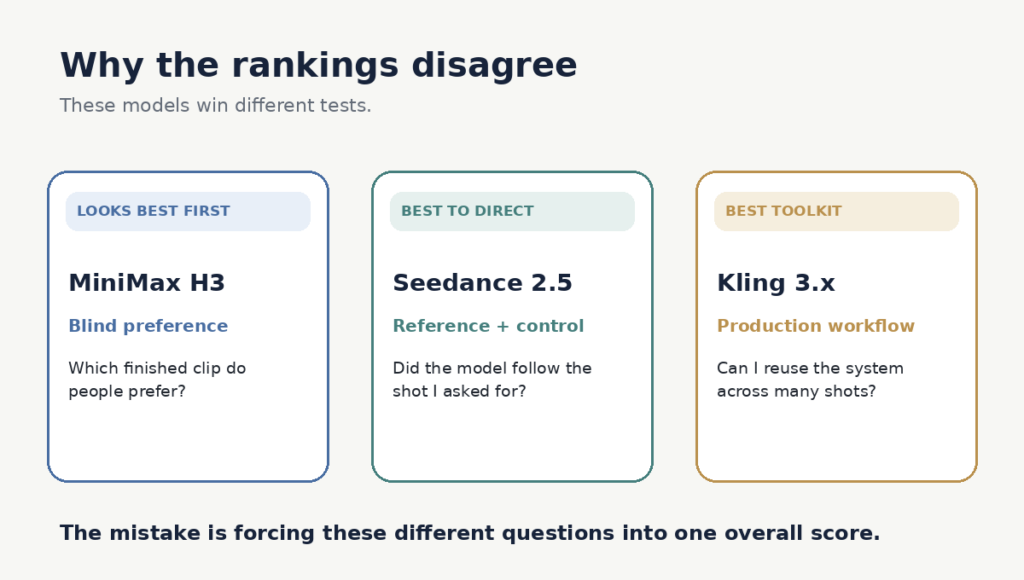
blind-preference test asks a simple question: Which finished clip do people prefer?
A working creator has to ask something harder: Can I keep the character consistent? Will the model follow the camera move? How many rerolls will this take? What happens when hands touch objects? And what does a usable result actually cost me?
Those are different tests.
In the August 14 Image-to-Video Arena snapshot, MiniMax H3 ranked first at 1489±7, Seedance 2.5 second at 1484±12, while Kling v3 Pro scored 1356±6. But those votes measure visual preference—not workflow, retries, reference control or production cost.
Once we separated those questions, the three models stopped looking like competitors for one crown. They started looking like tools built for different jobs.
The quick verdict
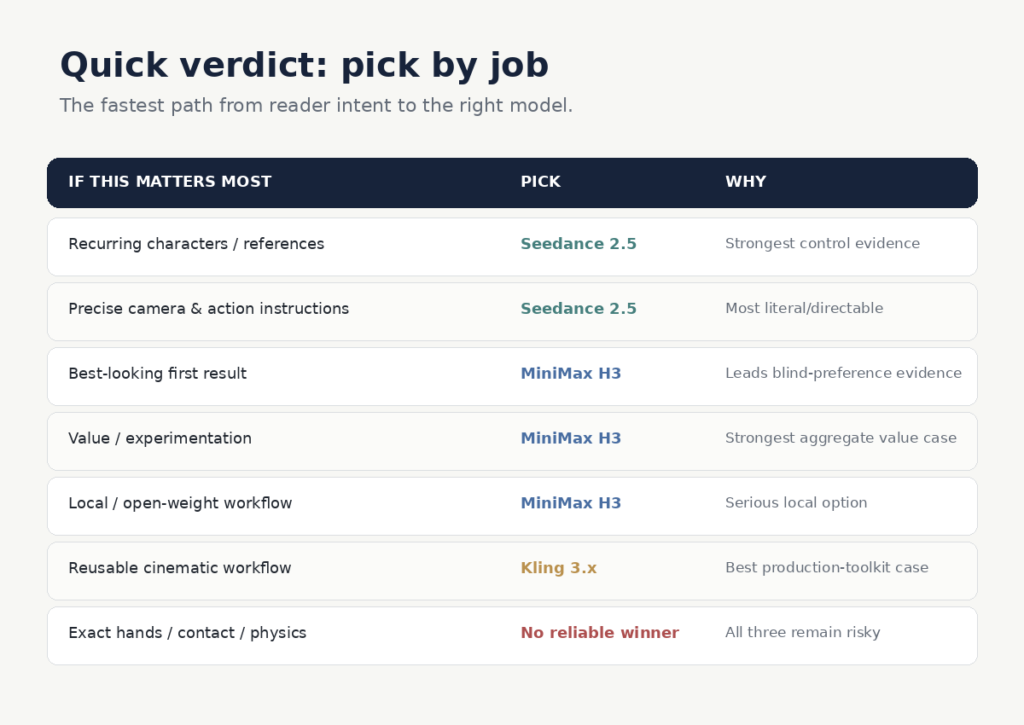
The short version is:
Seedance 2.5 makes the strongest case when control, recurring characters and reference fidelity matter most.
MiniMax H3 makes the strongest case for visual first impression, value and local/open-weight workflows.
Kling 3.x makes the strongest case as a reusable cinematic production toolkit.
For exact hands, contact and complex physical interaction, there is still no reliable winner.
Now the useful part is understanding why.
Seedance 2.5: best when you need the model to obey you
Seedance produced the clearest specialist win in our research.
Its strongest evidence appeared in reference fidelity, recurring-character consistency, prompt adherence and camera execution. It also has the strongest practical case of these three for longer connected single-pass storytelling.
ByteDance says Seedance 2.5 can generate up to 30 seconds in one pass and accept up to 50 multimodal reference assets. BytePlus currently offers 480p/720p Seedance 2.5 resource plans starting at $32 for 5 million tokens, valid for three months.
If your process begins with:
This is my character. This is my location. This is the camera move. These are the actions. Follow them.
Seedance is the strongest fit of these three.
The catch is that continuity is not the same as physical truth. Seedance can keep the person recognizable and the camera direction intact while still getting hand contact, object interaction or fast action wrong. Its premium also matters when a workflow requires several rerolls.
Verdict: choose Seedance when directability and reference continuity matter more than raw price.
MiniMax H3: best when you want visual punch, value or local control
H3 almost reverses the Seedance proposition.
Its reference and camera evidence is more mixed, and its workflow is unusually sensitive to prompt structure, reference roles, duration and resolution.
Yet H3 led the blind image-to-video preference evidence captured in our research and produced the strongest aggregate value signal of the three.
MiniMax describes H3 as an open model with multimodal text, image, video and audio context, native stereo audio, output up to 2K, and generations up to 15 seconds.
That gives buyers two legitimate paths:
Direct / technical: use MiniMax or the available H3 weights where the license and hardware fit your use case.
Hosted / convenient: use a platform such as AKOOL, which currently lists MiniMax H3 alongside other video models.
The weakness is operator sensitivity. Hosted and local H3 can have very different economics, and higher-resolution local generation can become slow quickly.
Verdict: choose H3 if visual first impression, experimentation economics or local ownership matter more than perfect literal obedience.
Kling 3.x: best when you want a production toolkit
Kling is the model most likely to look underrated if you judge it only by a leaderboard.
Its real case is the system around the generator: multi-shot, reusable elements, binding and Motion Control.
Experienced users are not merely asking Kling for a clip. They are building repeatable workflows around it.
That can produce excellent human-centric cinematic work—but it also creates one of the largest gaps between best-case demos and ordinary production yield. Fast movement, hands, head turns, occlusion and complicated body interaction repeatedly show up as failure triggers, and retries can become expensive.
Kling’s pricing is credit-based and varies with model, resolution, audio and plan. Because those costs move and depend heavily on settings, we would not publish one universal “Kling costs $X per second” figure.
Verdict: choose Kling if you want to learn and operate a reusable cinematic workflow rather than simply generate one impressive clip.
The failure frontier: none of them has solved this
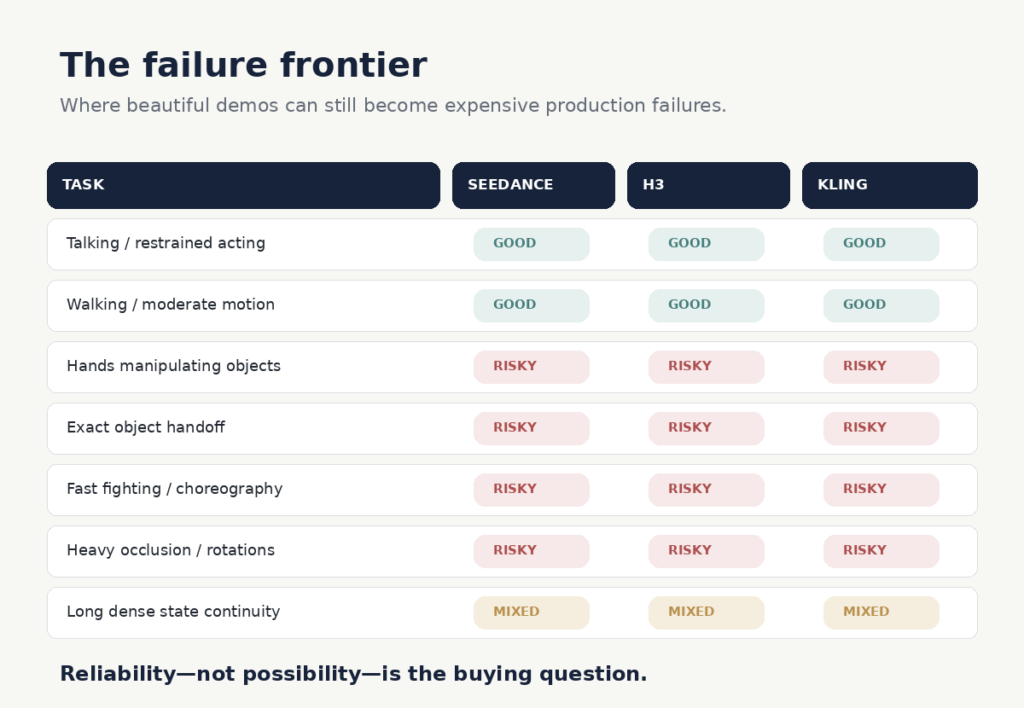
All three can produce spectacular examples of difficult motion.
That is different from producing them reliably.
The recurring danger zones were remarkably consistent: hands manipulating objects, precise object handoffs, contact-heavy choreography, heavy occlusion, large body rotations and long scenes where exact object or clothing state has to survive every change.
If a paid production depends on one of those actions, the smarter decision may be to redesign the shot rather than simply switch models.
The real price is cost per usable result
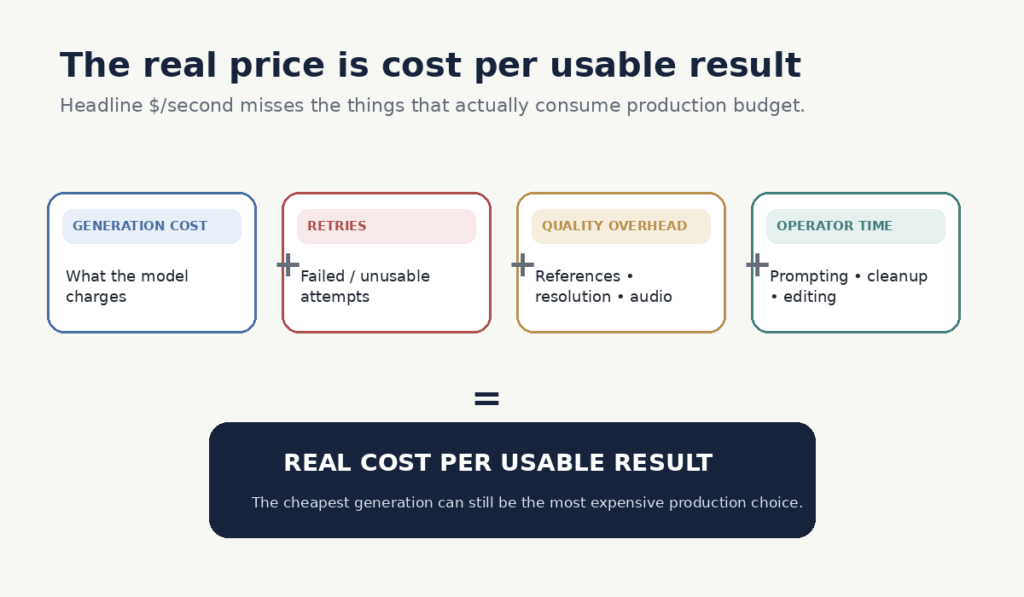
Most comparisons show price per generated second.
That misses the production cost.
A cheaper model that needs five attempts can easily cost more than a premium model that gives you the usable result in two. Add reference charges, resolution or audio overhead, and operator time, and headline pricing becomes even less informative.
That is why H3 can have a strong value case despite its workflow complexity.
It is why Seedance’s premium can make sense when one controlled longer take replaces several independently generated clips.
And it is why Kling’s economics can look completely different for an experienced Motion Control user and someone repeatedly burning credits on difficult shots.
Price per generated second tells you what generation costs. Cost per usable result tells you what production costs.
Which one should you choose?
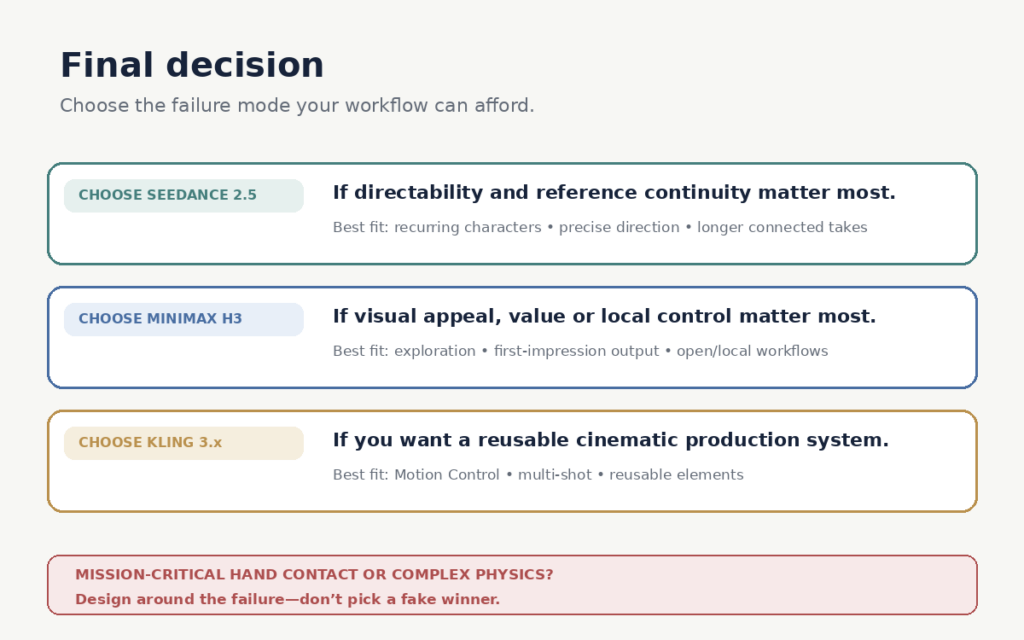
Choose Seedance 2.5 if recurring characters, references and precise creative direction matter most.
Choose MiniMax H3 if you prioritize visual appeal, experimentation value or local/open-weight control.
Choose Kling 3.x if you want a reusable cinematic workflow built around references, Motion Control and multi-shot production.
And if your project depends on perfect hands, object contact or complicated physical choreography:
choose the shot design before you choose the model.
Because the useful question is no longer:
Which AI video model is best?
It is:
Which model fails in ways my workflow can afford?
Frequently asked questions
Which AI video model is best overall: Seedance 2.5, MiniMax H3 or Kling 3.x?
There is no defensible universal winner. Seedance 2.5 has the strongest case for directability and reference consistency, H3 for visual preference and value, and Kling 3.x for reusable cinematic production workflows.
Which is best for consistent characters?
Seedance 2.5 produced the strongest evidence for recurring-character consistency and reference fidelity in our research. Kling can also be strong when references and its production tools are used well, while H3 was more variable.
Which is the cheapest to use?
Headline generation price is only part of the answer. MiniMax H3 showed the strongest overall value signal, but the real cost depends on retries, resolution, hosting, references and how often a generation produces something you can actually use.
Which model is best for realistic human movement?
None of the three is consistently reliable once scenes involve difficult hand contact, object interaction, heavy occlusion or complex choreography. For those shots, redesigning the action can matter more than changing models.
This comparison is based on a structured review of public evidence rather than a small internal test.
We coded 511 qualitative criterion-level observations across 212 distinct source lineages, alongside separate quantitative benchmark measurements.
Evidence was classified by model version and evaluation criterion, deduplicated, weighted by source quality and relevance, and checked for contradictions. Older model versions were treated as historical evidence unless the same behaviour remained visible in the current generation.
Collection stopped after two consecutive research batches produced no material change in the key conclusions.
The objective was not to identify the model with the best promotional demo. It was to determine which model is most defensible for different real production jobs.
Sources and updates
AI-video models change quickly. We verify major version, pricing and capability claims against current official documentation where possible, while performance conclusions draw from the broader evidence base described in our methodology.
Rankings and product capabilities may change as new model versions are released. When that happens, we update the affected evidence rather than quietly treating results from an older model as if they describe the current one.
About NakuNet
NakuNet researches technology from the buyer’s side.
We combine official documentation, benchmarks, independent testing, creator experience and broader public evidence to work out not simply what a product claims to do, but where it is actually useful, where it fails and who should spend money on it.
Leave a Reply